This Changes Everything: Why GEO is Shaking Up the SEO World (But Not How You Think)
Last Tuesday, I watched a seasoned digital marketer nearly spill her coffee all over her MacBook when someone mentioned that “SEO is dead.” The panic in her eyes was real – the kind of look you see when someone realizes they might have built their entire career on something that’s supposedly becoming obsolete. Sound familiar? If you’ve been in the digital marketing world lately, you’ve probably heard whispers (or outright declarations) about something called GEO vs SEO, and how artificial intelligence is supposedly turning everything upside down.
But here’s the thing – and this might surprise you – the sky isn’t actually falling. In fact, what’s happening in the search world right now is far more interesting and far less apocalyptic than the doom-and-gloom headlines suggest. The relationship between GEO (Generative Engine Optimization) and traditional SEO isn’t a death match; it’s more like a dance partnership where both partners bring something unique to the performance.
If you’re feeling overwhelmed by all the AI search talk, wondering whether you should throw out everything you know about SEO, or trying to figure out what this GEO thing even means, you’re in the right place. We’re going to cut through the noise, skip the jargon, and get to the heart of what’s really happening. By the time you finish reading this, you’ll understand not just what GEO vs SEO means for your content strategy, but how to make both work together to boost your visibility in ways you probably haven’t considered.
What’s All the Fuss About? Understanding the GEO Phenomenon
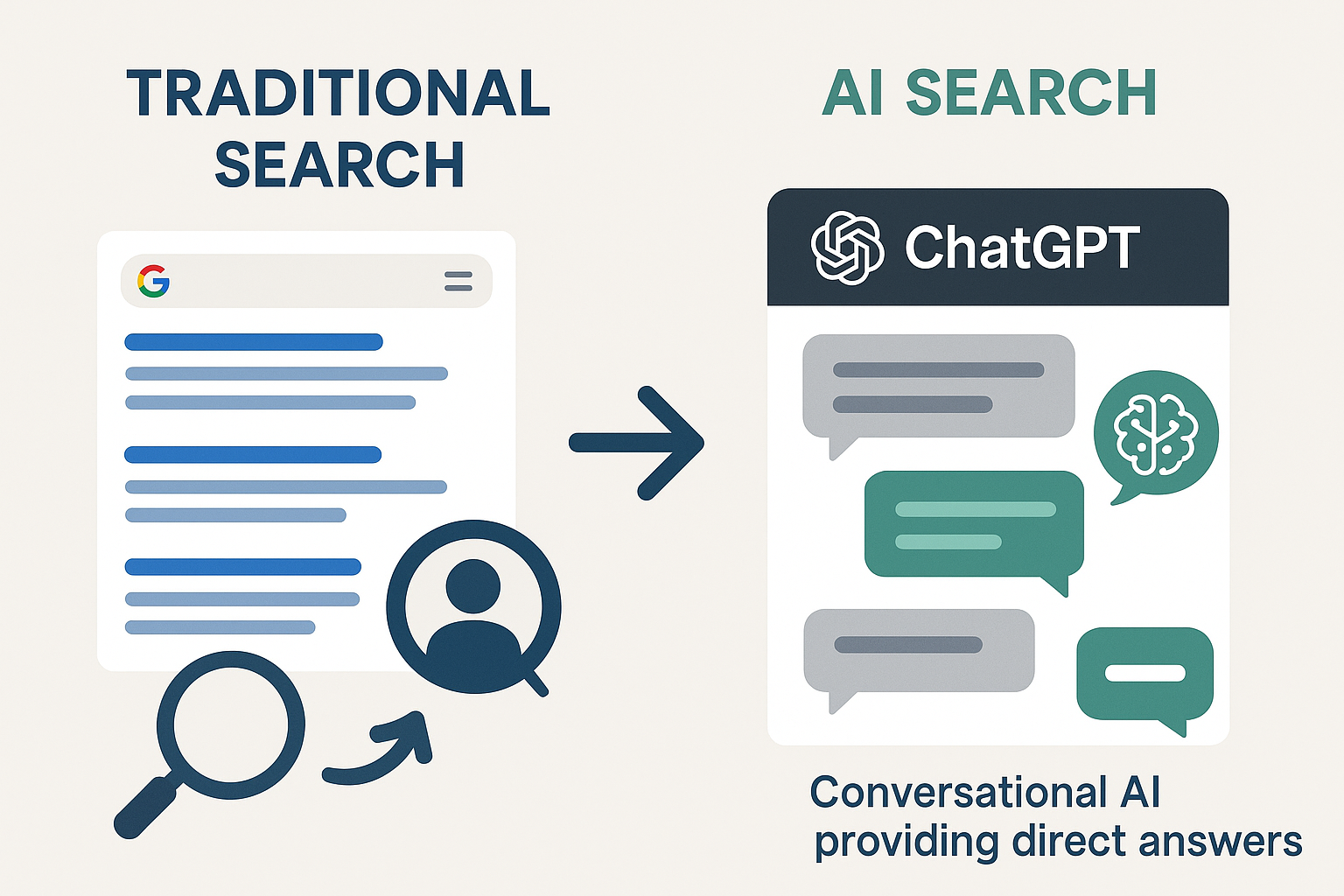
Remember that moment when ChatGPT first hit the scene? It was like watching the internet collectively lose its mind – in the best possible way. Suddenly, everyone was having conversations with an AI that could write poetry, solve math problems, and explain complex topics in simple terms. But for those of us in the search and content world, something else was happening that was equally revolutionary: people were starting to search differently.
Picture this: instead of typing “best pizza NYC” into Google and scrolling through ten blue links, users began asking ChatGPT, “What’s the best pizza place in New York City for a first date?” The AI would respond with a thoughtful answer, complete with recommendations, explanations, and even tips about ambiance and pricing. No clicking required. No scrolling through multiple websites. Just a direct, conversational answer.
This shift didn’t happen overnight, but when it did, it sent ripples through the digital marketing community. Enter GEO vs SEO – the conversation that’s been keeping content strategists up at night and spawning countless LinkedIn posts with dramatic titles.
So what exactly is GEO? Think of Generative Engine Optimization as the art and science of making your content appealing to AI systems like ChatGPT, Claude, Google’s Gemini, and Perplexity. Unlike traditional SEO, where you’re trying to rank high in search results, GEO is about getting your content cited, referenced, and featured in AI-generated responses. It’s like the difference between trying to get your restaurant listed first in the Yellow Pages versus getting the local food critic to mention your signature dish in their weekly column.
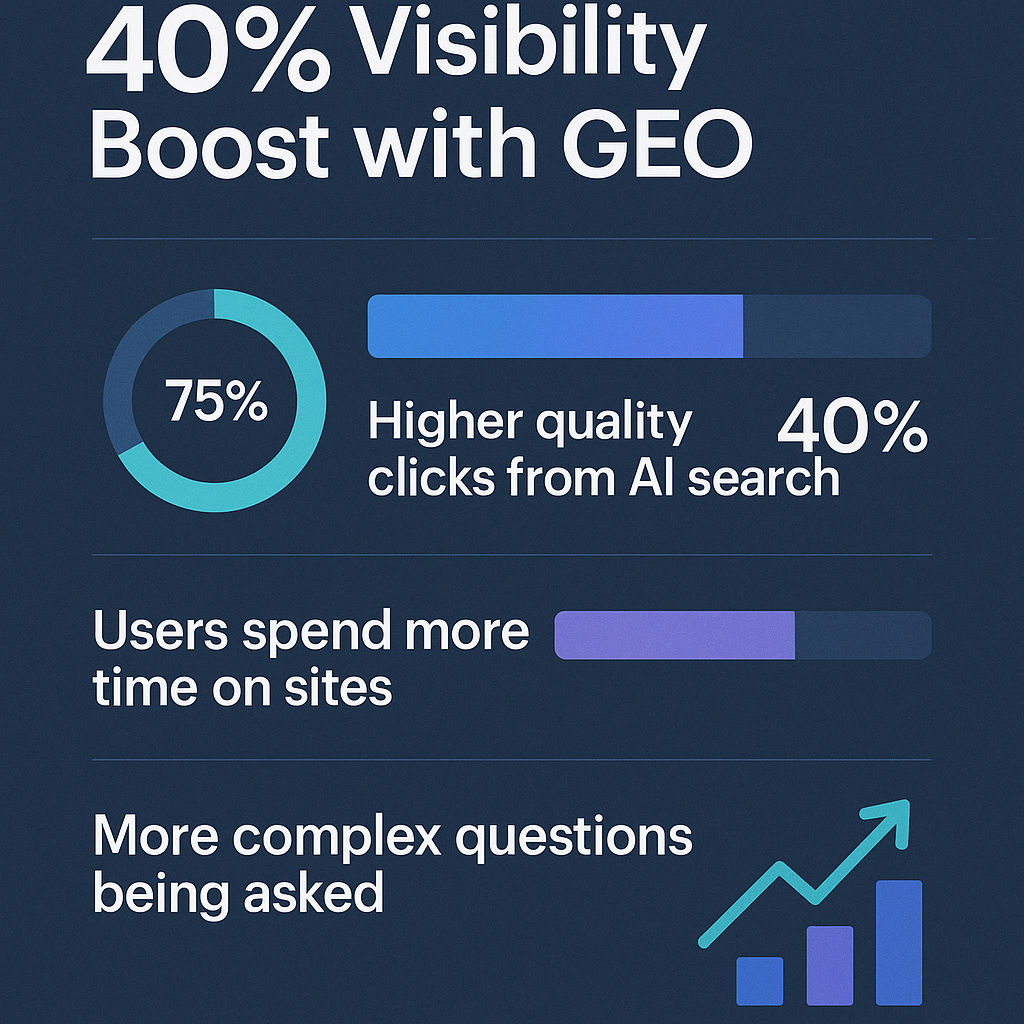
The numbers are pretty compelling too. A groundbreaking study from Princeton University found that effective GEO strategies can boost a brand’s visibility in AI responses by up to 40% [1]. That’s not a small bump – that’s the kind of increase that makes CFOs sit up and pay attention during budget meetings.
But here’s where it gets interesting (and where a lot of people get confused): GEO isn’t replacing SEO any more than email replaced phone calls. They’re different tools for different jobs, and the smartest marketers are figuring out how to use both effectively.
SEO Isn’t Going Anywhere (And Here’s Why)
Let me tell you about Maria, a small business owner who runs a boutique marketing agency in Austin, Texas. When all the GEO vs SEO chatter started heating up, she called me in a panic. “Should I fire my SEO consultant?” she asked. “Everyone’s saying traditional search is dead.”
I had to laugh – not at Maria, but at the situation. It reminded me of 2004 when people were declaring that email marketing was finished because social media was the “next big thing.” Or 2010 when everyone thought mobile apps would kill websites. Or 2016 when chatbots were supposedly going to replace customer service representatives. Spoiler alert: email marketing is still generating $42 for every dollar spent, websites are more important than ever, and I still can’t get a chatbot to understand that I want to speak to a human when my internet goes down.
The reality is that traditional search – the kind that SEO has been optimizing for decades – isn’t just surviving; it’s thriving. Google processes over 8.5 billion searches per day [2]. That’s billion with a B. People are still typing queries into search bars, still clicking on links, and still finding value in browsing through multiple sources to get the information they need.
But let’s get specific about why SEO remains crucial, because the reasons might surprise you. First, consider the intent behind different types of searches. When someone searches for “how to tie a tie,” they might be perfectly happy with an AI-generated response. But when they’re searching for “best divorce lawyer in Chicago,” they want to see credentials, read reviews, compare options, and make an informed decision. That’s where traditional search results shine.
Maria’s agency, for example, still gets 70% of its leads from organic search traffic. Her clients find her through searches like “marketing agency Austin” or “small business marketing consultant Texas.” These are high-intent searches from people ready to hire someone, and they want to see her website, read her case studies, and get a feel for her personality and approach. No AI response, no matter how well-crafted, can replace that human connection and detailed exploration.
There’s also the trust factor to consider. While AI responses are incredibly helpful for quick answers and general information, people still want to verify important information by visiting authoritative sources. It’s like getting directions from a friend versus using GPS – sometimes you want both perspectives to feel confident about your route.
The numbers back this up too. Despite all the AI innovation, organic search still drives 53% of all website traffic [3]. E-commerce sites get 37% of their traffic from search engines. B2B companies report that 71% of their website traffic comes from organic search. These aren’t small percentages that you can afford to ignore while chasing the latest trend.
Here’s another angle that often gets overlooked in the GEO vs SEO debate: local search. When someone searches for “coffee shop near me” or “emergency plumber,” they need real-time, location-specific results with contact information, hours, and directions. AI can provide general information about coffee shops or plumbing tips, but it can’t replace the immediate, actionable results that local SEO provides.
The Real Story: How GEO and SEO Work Together
Now here’s where things get really interesting, and where the whole GEO vs SEO narrative starts to fall apart. The smartest content creators and marketers aren’t choosing sides – they’re figuring out how to make both strategies work in harmony. It’s not a cage match; it’s a dance partnership where each partner brings unique strengths to create something better than either could achieve alone.
Let me share a story that perfectly illustrates this. Last month, I worked with a client who runs a sustainable fashion brand. She was worried about the GEO vs SEO question and wondered if she should completely overhaul her content strategy. Instead of choosing one approach over the other, we decided to optimize her content for both traditional search and AI platforms.
Here’s what we did: We took her existing blog post about “sustainable fabric choices” and enhanced it with both SEO and GEO best practices. For SEO, we optimized for keywords like “eco-friendly fabrics” and “sustainable clothing materials,” included internal links to product pages, and structured the content with clear headings and meta descriptions. For GEO, we added conversational FAQ sections, included specific statistics with proper citations, and wrote in a more natural, question-and-answer format that AI systems love to reference.
The results were remarkable. The post started ranking on the first page of Google for several target keywords (traditional SEO win), and it began getting cited in ChatGPT and Perplexity responses when people asked about sustainable fashion choices (GEO win). But here’s the kicker – the AI citations actually drove more traffic to her website because people wanted to learn more and see her products. The two strategies didn’t compete; they amplified each other.
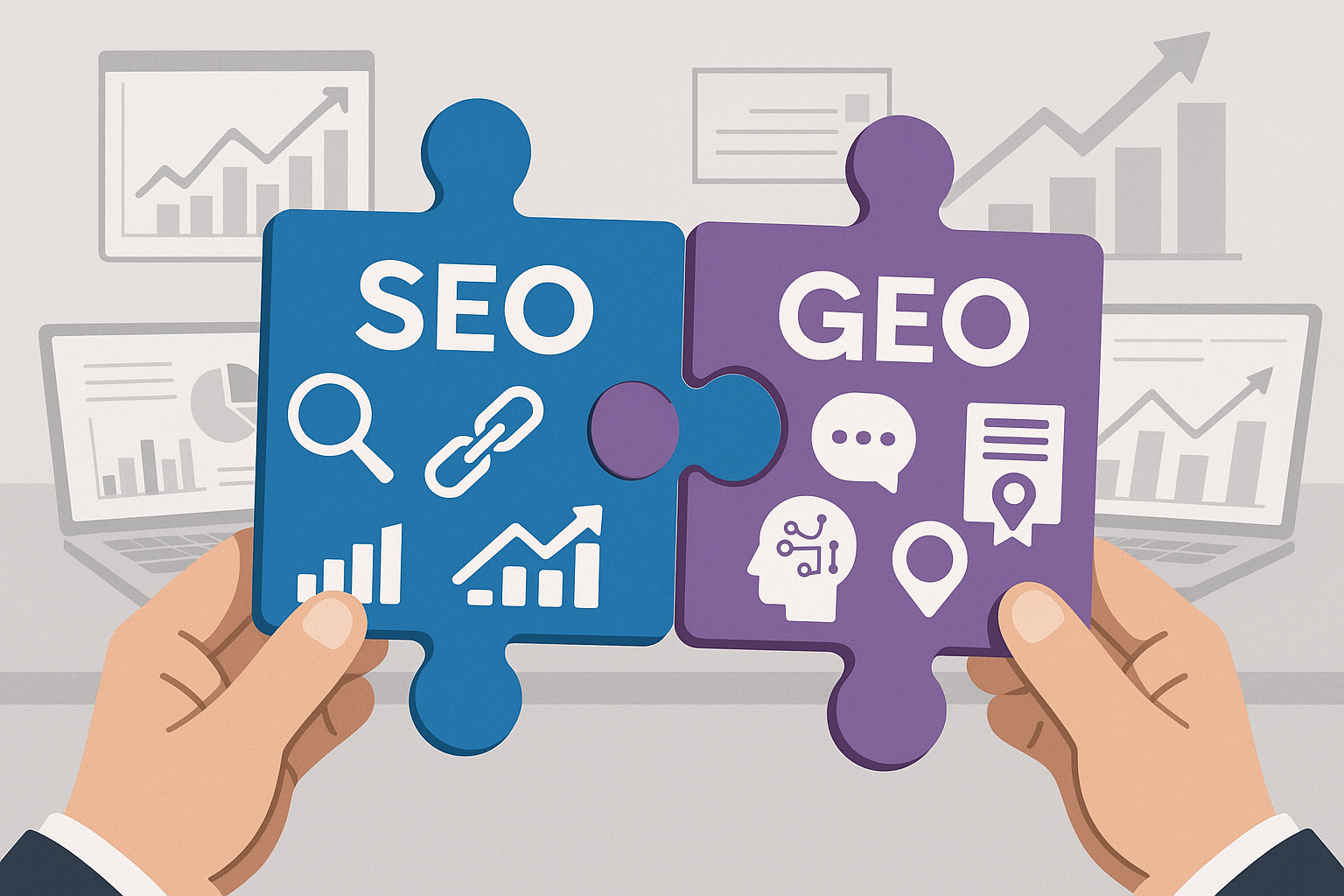
This synergy happens because both SEO and GEO reward the same fundamental principle: creating high-quality, helpful content that serves real user needs. Google’s algorithm updates over the years have consistently moved toward rewarding content that demonstrates expertise, authoritativeness, and trustworthiness (E-A-T). AI systems, it turns out, are looking for similar signals when deciding which sources to cite and reference.
The key insight here is understanding that your audience isn’t just using one type of search. The same person might ask ChatGPT for a quick explanation of sustainable fabrics in the morning, then do a Google search for “best sustainable clothing brands” in the afternoon, and finally search for “sustainable fashion store near me” in the evening. Each search serves a different purpose and requires a different type of optimization.
Consider the customer journey in today’s multi-platform search environment. Someone might start with an AI query to understand a concept, use traditional search to research specific options, and then return to AI for comparison and decision-making support. Your content needs to be discoverable and valuable at every stage of this journey.
This is where the magic happens in the GEO vs SEO relationship. When your content is optimized for both, you create multiple touchpoints with potential customers. They might first encounter your brand through an AI citation, then visit your website through a traditional search result, and finally convert after seeing your content referenced again in an AI comparison.
The technical aspects work together beautifully too. The structured data that helps search engines understand your content also helps AI systems parse and cite your information accurately. The clear, authoritative writing that ranks well in Google also gets picked up by AI platforms looking for reliable sources. The internal linking that boosts your SEO also helps AI systems understand the context and relationships between your content pieces.
The 4 Game-Changing Differences You Need to Know
While GEO and SEO work beautifully together, they’re definitely not the same thing. Understanding their key differences is crucial for developing an effective strategy that leverages both approaches. Think of it like understanding the difference between playing piano and guitar – both are musical instruments, both can create beautiful music, but they require different techniques and serve different purposes in an orchestra.
1. Target Platforms: Where Your Content Lives and Thrives
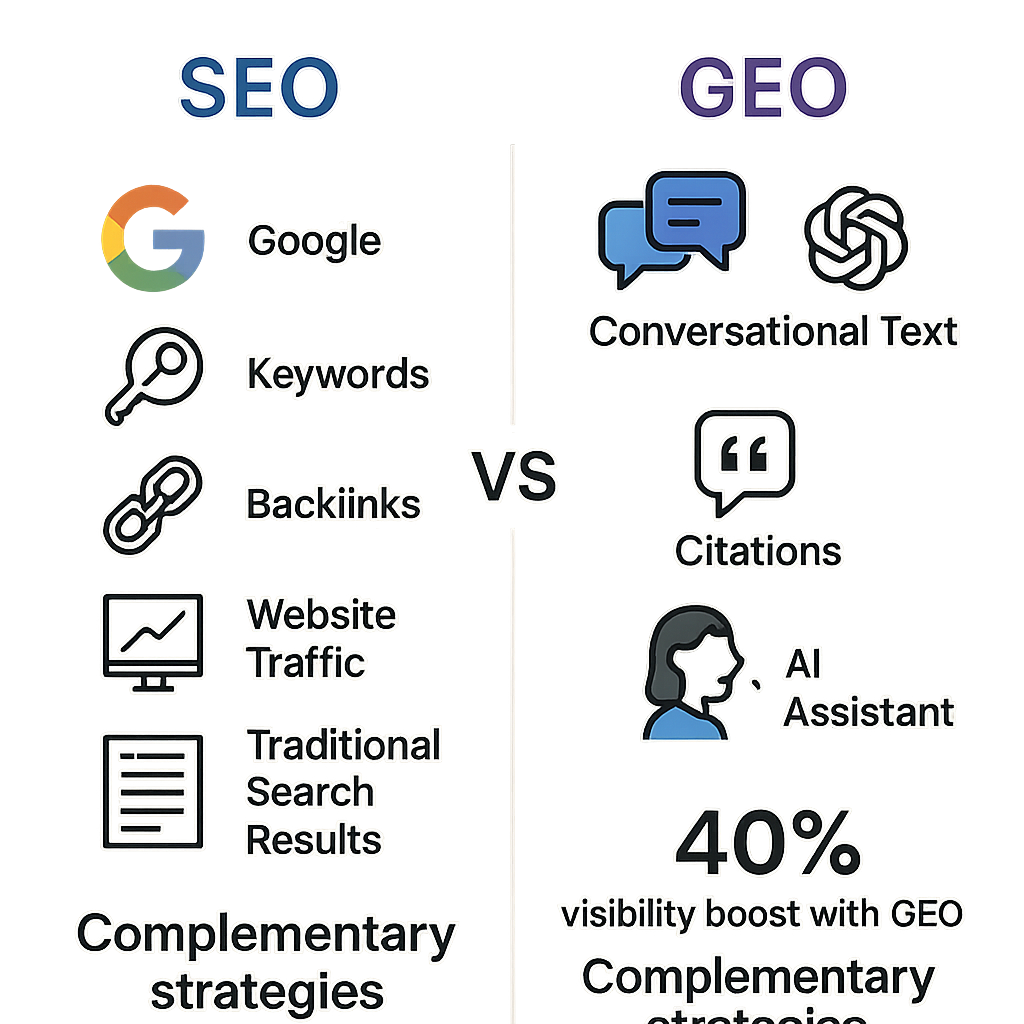
The most fundamental difference in the GEO vs SEO equation is where your content needs to perform. Traditional SEO focuses on search engines like Google, Bing, and Yahoo – platforms where users type queries and receive lists of links to explore. It’s like optimizing for a library catalog system where people browse through organized results to find what they need.
GEO, on the other hand, targets AI-powered platforms like ChatGPT, Claude, Google’s Gemini, Perplexity, and emerging AI search tools. These platforms don’t just index your content; they read it, understand it, and potentially cite it in conversational responses. It’s more like optimizing to be quoted by a knowledgeable expert who synthesizes information from multiple sources.
Here’s a practical example: When someone searches “how to start a podcast” on Google, they’ll see a list of articles, guides, and resources they can click through. Your SEO-optimized content needs to appear in those results and entice clicks with compelling titles and meta descriptions. But when someone asks ChatGPT the same question, the AI might synthesize information from multiple sources and provide a comprehensive answer, potentially citing your content as a reference for specific points like “According to [Your Brand], the most important first step is defining your target audience.”
The platform difference also affects how you measure success. With traditional SEO, you track rankings, click-through rates, and organic traffic. With GEO, you’re looking at citation frequency, brand mentions in AI responses, and the quality of how your content is represented in AI-generated answers.
2. Best Practices: Keywords vs. Conversations
This is where things get really interesting in the GEO vs SEO world. Traditional SEO has long been built around keyword optimization – identifying the terms people search for and strategically incorporating them into your content. You research keywords, analyze search volume, assess competition, and craft content that targets specific phrases people type into search boxes.
GEO flips this approach on its head. Instead of focusing on specific keywords, GEO prioritizes conversational, natural language that mirrors how people actually speak and ask questions. AI systems are trained on human conversations and natural language patterns, so they respond better to content that sounds like it was written by a human for humans, not by a robot for robots.
Let me give you a concrete example. For traditional SEO, you might optimize a blog post with the keyword “best project management software” and include variations like “top project management tools” and “project management software comparison.” You’d strategically place these phrases in your title, headings, and throughout the content while maintaining a keyword density of 1-2%.
For GEO, you’d approach the same topic more conversationally. Instead of keyword-stuffed content, you’d write sections that answer natural questions like “What should I look for in project management software?” or “How do I choose the right project management tool for my team?” You’d include specific statistics, quotes from experts, and detailed explanations that AI systems can easily parse and cite.
The GEO approach also heavily emphasizes FAQ sections, which have become incredibly valuable for AI optimization. These sections naturally mirror the question-and-answer format that AI systems use to provide information. When someone asks an AI about project management software, it can directly pull from your FAQ section to provide specific, attributed answers.
3. Tools: Established Giants vs. Emerging Players
The tool landscape in the GEO vs SEO space tells an interesting story about how quickly the digital marketing world is evolving. Traditional SEO has mature, established tools that have been refined over decades. Platforms like Ahrefs, SEMrush, and Moz offer comprehensive keyword research, backlink analysis, rank tracking, and competitive intelligence. These tools have massive databases, sophisticated algorithms, and proven track records.
GEO tools, by contrast, are still in their infancy. We’re seeing the emergence of platforms like AthenaHQ, Goodie AI, and HubSpot’s AI Search Grader, but the space is still developing rapidly. These tools focus on monitoring how AI platforms reference your brand, optimizing content for AI citation, and tracking your visibility in AI-generated responses.
The difference in tool maturity reflects the broader difference between these strategies. SEO tools can tell you exactly how many people search for “sustainable fashion” each month, which websites rank for that term, and what backlinks they have. GEO tools are still figuring out how to measure and predict AI citation patterns, which is inherently more complex because AI responses are generated dynamically rather than ranked statically.
This creates both challenges and opportunities. The challenge is that GEO optimization currently requires more intuition and experimentation than data-driven precision. The opportunity is that early adopters can gain significant advantages while the space is still developing and competition is relatively low.
4. Traffic Generation: Clicks vs. Citations
Perhaps the most significant difference in the GEO vs SEO debate is how each strategy generates value for your business. Traditional SEO is fundamentally about driving traffic to your website. Success is measured in clicks, page views, and conversions that happen on your site. When your content ranks well, people click through to read more, explore your products, and hopefully become customers.
GEO operates on a different model entirely. Instead of driving direct traffic, GEO focuses on getting your content cited and referenced in AI responses. This means people might learn about your brand, your expertise, or your products without ever visiting your website. It’s like being quoted in a newspaper article – valuable for brand awareness and credibility, but not necessarily driving immediate website traffic.
This difference has profound implications for how you measure ROI and success. A successful SEO campaign might drive thousands of visitors to your website each month, leading to measurable conversions and revenue. A successful GEO campaign might result in your brand being mentioned in hundreds of AI responses, building awareness and authority that’s harder to track but potentially just as valuable.
However, here’s where it gets interesting: Google’s own data shows that clicks from AI-enhanced search results (like AI Overviews) tend to be higher quality. Users who click through after seeing AI-generated summaries spend more time on sites and are more engaged with the content [4]. This suggests that while GEO might generate fewer direct clicks, those clicks could be more valuable.
The key is understanding that both types of value matter. Direct website traffic from SEO provides immediate, measurable results. Brand mentions and citations from GEO build long-term authority and awareness that can compound over time. The most successful strategies leverage both approaches to create multiple pathways to business growth.
Google’s Take: What the Search Giant Really Wants
When Google speaks, the SEO world listens – sometimes with the intensity of students cramming for a final exam. So when Google’s Search Central team published their official guidance on succeeding in AI search experiences, it sent ripples through the entire GEO vs SEO conversation. The good news? Google’s message was surprisingly reassuring and practical.
John Mueller, one of Google’s most trusted voices in the search community, essentially told us what many of us suspected but were afraid to believe: the fundamentals haven’t changed as much as the headlines suggest. In Google’s official blog post about AI search optimization, they emphasized that “the underpinnings of what Google has long advised carries across to these new experiences” [5].
Let me translate that from Google-speak into plain English: if you’ve been doing good SEO all along – creating helpful, authoritative content that serves real user needs – you’re already on the right track for AI search success. It’s like discovering that the healthy eating habits you’ve been developing also happen to be perfect for the new fitness program you want to try.
But Google didn’t just offer reassurance; they provided specific guidance that bridges the GEO vs SEO gap beautifully. Their recommendations focus on six key areas that work for both traditional and AI search optimization.
First, they emphasized creating “unique, non-commodity content that visitors from Search and your own readers will find helpful and satisfying.” This is crucial because AI systems are trained to identify and cite authoritative, original sources. Generic, rehashed content that might have squeaked by in traditional SEO won’t cut it in the AI world.
The second point addresses something many people worry about in the GEO vs SEO transition: page experience. Google stressed that even the best content can disappoint users if it’s presented poorly. This means your website still needs to load quickly, work well on mobile devices, and provide a smooth user experience. AI might help people discover your content, but they still need to have a good experience when they visit your site.
Google’s third recommendation tackles a technical aspect that’s often overlooked: making sure your content is accessible to both traditional crawlers and AI systems. This includes proper structured data markup, clear site architecture, and ensuring that your most important content isn’t hidden behind JavaScript or other technical barriers.
Here’s where Google’s guidance gets really interesting for the GEO vs SEO discussion: they explicitly mentioned that AI search experiences are leading to higher-quality traffic. According to their data, people who click through to websites from AI-enhanced search results tend to be more engaged and spend more time on sites. This suggests that optimizing for AI search isn’t just about brand awareness – it can actually improve the quality of your website traffic.
Google also addressed the elephant in the room: content control. They reminded site owners that they can use existing tools like nosnippet, data-nosnippet, and max-snippet to control how their content appears in AI experiences. This is crucial for businesses that want to balance visibility with protecting proprietary information.
Perhaps most importantly, Google emphasized that AI search represents an evolution, not a revolution. They compared it to previous search developments like the shift from “ten blue links” to rich results, mobile optimization, and voice search. Each of these changes required adaptation, but they didn’t make previous optimization efforts obsolete.
The message is clear: Google sees GEO and SEO as complementary strategies, not competing ones. They’re encouraging content creators to focus on fundamental quality and user value while adapting to new formats and opportunities. It’s like they’re saying, “Keep doing what you’re doing well, but also learn these new dance moves.”
Your Action Plan: Mastering Both Worlds
Alright, enough theory – let’s get practical. If you’re feeling overwhelmed by the whole GEO vs SEO situation and wondering where to start, I’ve got you covered. The beauty of this approach is that you don’t need to choose sides or completely overhaul your existing strategy. Instead, you’re going to enhance what you’re already doing while adding some new techniques to your toolkit.
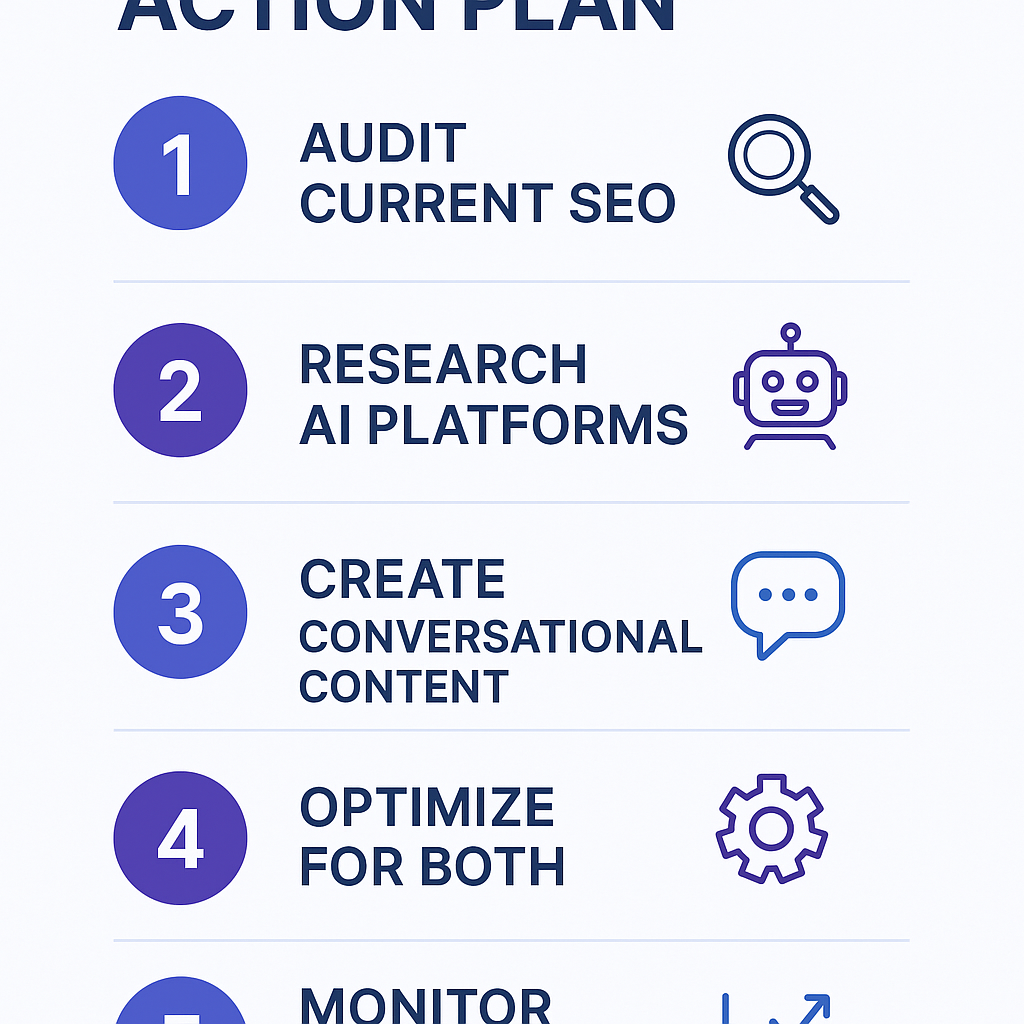
Step 1: Audit Your Current SEO Foundation
Before you start optimizing for AI search, you need to make sure your traditional SEO house is in order. This isn’t about starting from scratch – it’s about identifying what’s working well and what needs improvement. Think of it like renovating a house: you want to keep the solid foundation while updating the features that need attention.
Start by reviewing your top-performing content from the past year. What topics are driving the most organic traffic? Which pieces are ranking well for your target keywords? This content represents your strongest foundation for expansion into GEO optimization. These are the pieces that are already proving their value to search engines and users, making them prime candidates for AI optimization.
Next, look at your content gaps. Are there topics your audience frequently asks about that you haven’t covered comprehensively? Are there questions in your industry that don’t have great answers online? These gaps represent opportunities to create content that serves both traditional search and AI platforms.
Pay special attention to your FAQ sections and how-to content. These formats naturally align with both SEO and GEO best practices because they directly answer user questions in a clear, structured way. If you don’t have much content in these formats, that’s your first priority.
Step 2: Research AI Platform Behavior
This step is where GEO vs SEO strategy gets interesting. You need to understand how AI platforms currently handle topics in your industry. Spend some time asking ChatGPT, Claude, Perplexity, and Google’s AI features questions that your target audience would ask. Pay attention to which sources they cite, how they structure their responses, and what types of information they prioritize.
For example, if you’re in the fitness industry, ask these platforms questions like “What’s the best workout routine for beginners?” or “How do I choose the right protein powder?” Notice which websites and sources get mentioned in the responses. This gives you insight into what AI systems consider authoritative and cite-worthy in your space.
Document the patterns you see. Do AI platforms prefer content with specific statistics? Do they cite academic sources more often than blog posts? Do they favor content that includes expert quotes or first-person experiences? These insights will guide your content optimization strategy.
Step 3: Create Hybrid Content
Now comes the fun part: creating content that works beautifully for both traditional search and AI platforms. This isn’t about writing two separate pieces – it’s about crafting content that naturally serves both purposes.
Start with your keyword research, but expand it to include conversational queries. If your target keyword is “email marketing best practices,” also consider how people might ask about this topic in conversation: “What are the most effective email marketing strategies?” or “How can I improve my email marketing results?”
Structure your content to serve both needs. Use clear headings that include your target keywords for SEO, but write the actual content in a natural, conversational tone that AI systems can easily parse and cite. Include specific statistics, expert quotes, and actionable advice that AI platforms love to reference.
Don’t forget about FAQ sections – they’re gold for both SEO and GEO. Create comprehensive FAQ sections that address common questions in your industry. These sections often rank well in traditional search results and provide perfect content for AI systems to cite when answering user questions.
Step 4: Optimize Technical Elements
The technical side of GEO vs SEO optimization is where many people get stuck, but it doesn’t have to be complicated. Focus on the elements that serve both strategies effectively.
Structured data markup is crucial for both SEO and GEO success. Schema markup helps search engines understand your content better, and it also helps AI systems parse and cite your information accurately. Focus on article schema, FAQ schema, and how-to schema for maximum impact.
Make sure your site loads quickly and works well on all devices. This has always been important for SEO, but it’s equally crucial for GEO because AI systems consider user experience signals when determining which sources to cite and recommend.
Pay attention to your internal linking structure. Good internal linking helps search engines understand the relationships between your content pieces, and it also helps AI systems understand the context and authority of your information.
Step 5: Monitor and Adjust
The final step in mastering both GEO and SEO is developing a monitoring system that tracks success across both strategies. This is where the emerging GEO tools become valuable, but you can also do a lot of manual monitoring while the tool ecosystem develops.
For traditional SEO, continue using your existing tools to track rankings, traffic, and conversions. But also start monitoring how your content performs in AI search results. Set up Google Alerts for your brand name and key topics to catch when your content gets cited in AI responses.
Create a simple spreadsheet to track AI citations manually. Regularly search for your target topics on different AI platforms and note when your content gets referenced. This manual process might seem tedious, but it provides valuable insights into which content formats and topics work best for AI optimization.
Most importantly, be patient and consistent. Both SEO and GEO are long-term strategies that require consistent effort and continuous refinement. The businesses that succeed in this new landscape will be those that commit to serving their audience with valuable content across all platforms and search experiences.
The Future is Bright (And Less Scary Than You Think)
As we wrap up this deep dive into the GEO vs SEO landscape, I want to leave you with a story that perfectly captures why I’m optimistic about the future of search and content marketing. Last week, I had coffee with Sarah, a content manager at a mid-sized B2B software company. Six months ago, she was panicking about AI search and wondering if her SEO efforts were becoming obsolete. Today, she’s seeing the best results of her career.
Here’s what changed: instead of viewing GEO and SEO as competing strategies, Sarah embraced them as complementary tools. She started optimizing her existing high-performing content for AI citation while continuing to create new content that served both traditional search and AI platforms. The results were remarkable – her organic traffic increased by 35%, but more importantly, her brand started getting mentioned in AI responses across multiple platforms, leading to new partnership opportunities and speaking engagements she never would have discovered through traditional SEO alone.
Sarah’s success story isn’t unique. Across industries, the content creators and marketers who are thriving in this new landscape are those who’ve stopped seeing change as a threat and started viewing it as an opportunity. They’re the ones who understand that the fundamental goal hasn’t changed – we’re still trying to create valuable content that helps people solve problems and make decisions. The platforms and formats might be evolving, but the core mission remains the same.
The future of search is actually more exciting than scary when you think about it. We’re moving toward a world where high-quality, helpful content gets rewarded across multiple platforms and formats. Generic, low-value content that might have ranked well through keyword manipulation in the past is becoming less effective, while authoritative, well-researched content that truly serves user needs is becoming more valuable than ever.
This shift benefits everyone – content creators who focus on quality, businesses that prioritize customer value, and users who get better, more relevant information regardless of how they search for it. It’s like the internet is finally growing up and rewarding the behaviors we always knew were right but weren’t always incentivized.
The GEO vs SEO conversation will continue to evolve as AI technology advances and new platforms emerge. But the businesses that will succeed are those that focus on the fundamentals: understanding their audience, creating genuinely helpful content, and adapting to new opportunities while maintaining their core values and expertise.
So here’s my challenge to you: stop worrying about whether GEO is replacing SEO and start thinking about how you can use both strategies to better serve your audience. The future belongs to content creators who embrace change while staying true to their mission of providing real value to real people.
The search landscape is changing, but it’s changing in ways that reward the best practices we’ve always known were important. Quality content, user focus, and authentic expertise are more valuable than ever. The only difference is that now you have more ways to get that valuable content in front of the people who need it most.
That’s not scary – that’s exciting. And if you approach it with the right mindset and strategies, it’s also incredibly rewarding. The future of search is bright, and there’s room for everyone who’s committed to creating content that truly matters.
Ready to master both GEO and SEO for your content strategy? Start by auditing your current content and identifying opportunities to optimize for both traditional search and AI platforms. The future of search visibility belongs to those who embrace both approaches.
Ready to take your content strategy to the next level? Start with a comprehensive audit of your current SEO foundation and uncover opportunities for GEO optimization. By combining traditional search with AI-driven strategies, you can stay ahead of the curve and drive even more value to your audience. Don’t wait—embrace the future of search today and set your content up for success! Start optimizing now and unlock the potential of both GEO and SEO for your business.