Google Maps 3-Pack Ranking Factors: 5 Signals That Work
Quick Answer: If your business isn't appearing in Google's Maps 3-Pack, it's almost certainly because you're missing on one or more of the five core Google Maps 3-pack ranking factors: proximity, relevance, prominence, review signals, and behavioral engagement. Fixing even two or three of these systematically can move a local business from page-two obscurity into the coveted three-spot cluster — often within 60–90 days.
What Exactly Is the Google Maps 3-Pack, and Why Does It Matter So Much?
If you've ever Googled "dentist near me" or "plombier Montréal" on your phone, you've seen it: the boxed cluster of three business listings that appears above the organic results, armed with star ratings, phone numbers, and a mini-map. That's the Google Maps 3-Pack (sometimes called the Local Pack).
Here's why it's worth obsessing over:
- 42% of local searchers click one of those three listings (BrightLocal, 2024)
- Listings in the 3-Pack receive 5× more clicks than the #4 organic result sitting just below them
- On mobile — where over 63% of local searches now happen — the 3-Pack often occupies the entire first screen
If you're a Montreal roofer, a Laval physiotherapist, or a South Shore restaurant owner, and you're not in those three spots, you are essentially invisible to the majority of customers who are actively looking to buy right now.
The brutal truth we tell every client at Mainstream Digicom: ranking in Google Maps is a separate game from ranking in regular Google search. Your website's domain authority barely moves the needle here. What matters is an entirely different stack of signals.
How Does Google Actually Decide Who Makes the 3-Pack?
Google's own documentation distills its local ranking algorithm into three pillars:
- Relevance — How well your Business Profile matches what the searcher is looking for
- Distance — How far your location is from the searcher (or from the location they specified)
- Prominence — How well-known and reputable Google believes your business to be
Simple on paper. Brutal in practice. Because each pillar breaks into dozens of sub-signals, and competitors who understand those sub-signals will consistently outrank you even if your business is objectively better.
Below, we break down the five operational ranking factors that — in our work with small businesses across Greater Montreal — consistently move the needle most.
Signal #1: Is Your Google Business Profile Actually Complete and Optimized?
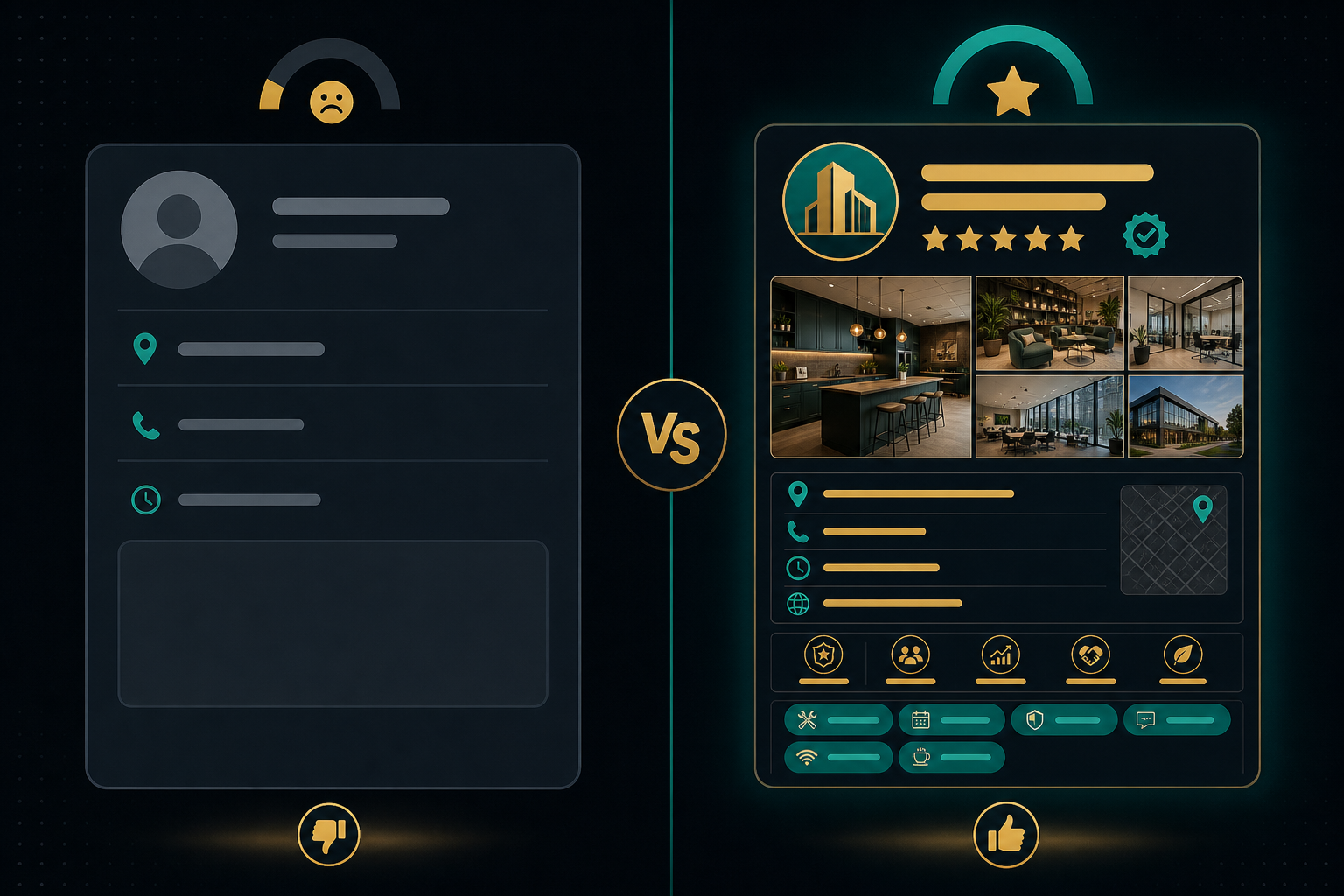
Your Google Business Profile (GBP) is the single most powerful document you control in local SEO. Think of it as a dedicated micro-website that Google trusts more than your actual website for Maps purposes.
What "complete" really means
Most business owners create a GBP, fill in the name and phone number, and call it done. That's the bare minimum — and it leaves enormous ranking potential on the table.
A fully optimized GBP includes:
- Primary and secondary categories (e.g., "Roofing Contractor" as primary + "Gutter Cleaning Service" as secondary) — this is the single highest-impact field
- Business description using your target keywords naturally in the first 250 characters
- Products and services with individual descriptions and prices where applicable
- At least 10 high-resolution photos, updated regularly (Google's own data shows profiles with photos receive 42% more requests for directions)
- Business hours including holiday hours — inconsistency is a trust killer
- Q&A section seeded with your own questions and answers
The "keyword in business name" trap
We see it constantly in competitive Montreal verticals: competitors stuffing keywords into their GBP name (e.g., "Joe's Plumbing — Best Plumber Montreal 24/7"). This violates Google's guidelines and should be reported. Don't do it yourself. Google is getting better at penalizing it.
Signal #2: Are Your NAP Citations Consistent Across the Web?
NAP stands for Name, Address, Phone number — and its consistency across every directory, social profile, and data aggregator on the internet is a foundational Google Maps 3-pack ranking factor.
Here's why it matters: Google cross-references dozens of data sources to verify that a business is real and located where it claims to be. Every inconsistency — a suite number missing on Yelp, an old phone number on PagesJaunes.ca, a slightly different business name on Facebook — introduces doubt.
The Montreal-specific citation landscape
For businesses in Quebec, your citation audit needs to cover:
- Google Business Profile (obviously)
- Apple Maps (often overlooked, feeds Siri searches)
- Yelp Canada
- PagesJaunes / YellowPages.ca
- Facebook Business Page
- Better Business Bureau (BBB)
- Bing Places
- Industry-specific directories (e.g., Houzz for contractors, RateMDs for healthcare)
We use tools like BrightLocal or Whitespark's Local Citation Finder to audit clients. A typical Montreal SME we onboard has NAP errors in 40–60% of their existing citations. Fixing those alone — with no other changes — has moved clients up one to two positions in the local pack within 45 days.
Signal #3: Do Your Reviews Send the Right Signals?
Reviews are where the rubber meets the road for Google Maps 3-pack ranking factors, and most business owners are thinking about them all wrong.
It's not just about having a high star rating. Google's algorithm reads reviews for three distinct signals:
Volume
More reviews signal a more active, trustworthy business. A business with 200 reviews at 4.2 stars will typically outrank one with 15 reviews at 4.9 stars in a competitive market.
Recency
Google heavily weights recent review velocity. A burst of 50 reviews in 2019 and nothing since then hurts you. Aim for a consistent flow: even 3–5 new reviews per month keeps your profile fresh.
Keyword richness in review text
When a customer writes "best Italian restaurant in Griffintown" in their review, Google reads that as a relevance signal. You can't write reviews for yourself, but you can train your team to ask happy customers to mention the specific service or neighbourhood in their feedback.
Responding to reviews
Responding to every review — positive or negative — is both a ranking signal and a conversion signal. Businesses that respond to reviews are seen as more engaged, and Google rewards engagement. Keep responses professional, varied (don't copy-paste), and timely (within 48 hours).
Signal #4: Does Your Website Back Up What Your GBP Claims?
Here's a connection many business owners miss: your website is a ranking factor for your GBP, not just for organic search.
Google looks at your website to validate the relevance and legitimacy of your Business Profile. Specifically:
- Landing page URL linked from your GBP — is it optimized for your primary category and city? A Montreal electrician's linked page should mention "électricien Montréal" or "Montreal electrician," have a local phone number (not a tracking number with a different area code), and embed a Google Map
- Structured data (Schema markup) — LocalBusiness schema on your homepage tells Google your NAP, hours, and service area in machine-readable format
- Location-specific content — service area pages for Laval, Longueuil, Brossard, etc., strengthen relevance signals for searches happening in those areas
At Mainstream Digicom, every local SEO engagement includes a website co-optimization pass because we've seen GBP optimization plateau without it. The profile and the site have to speak the same language.
Signal #5: Are People Actually Engaging With Your Listing?
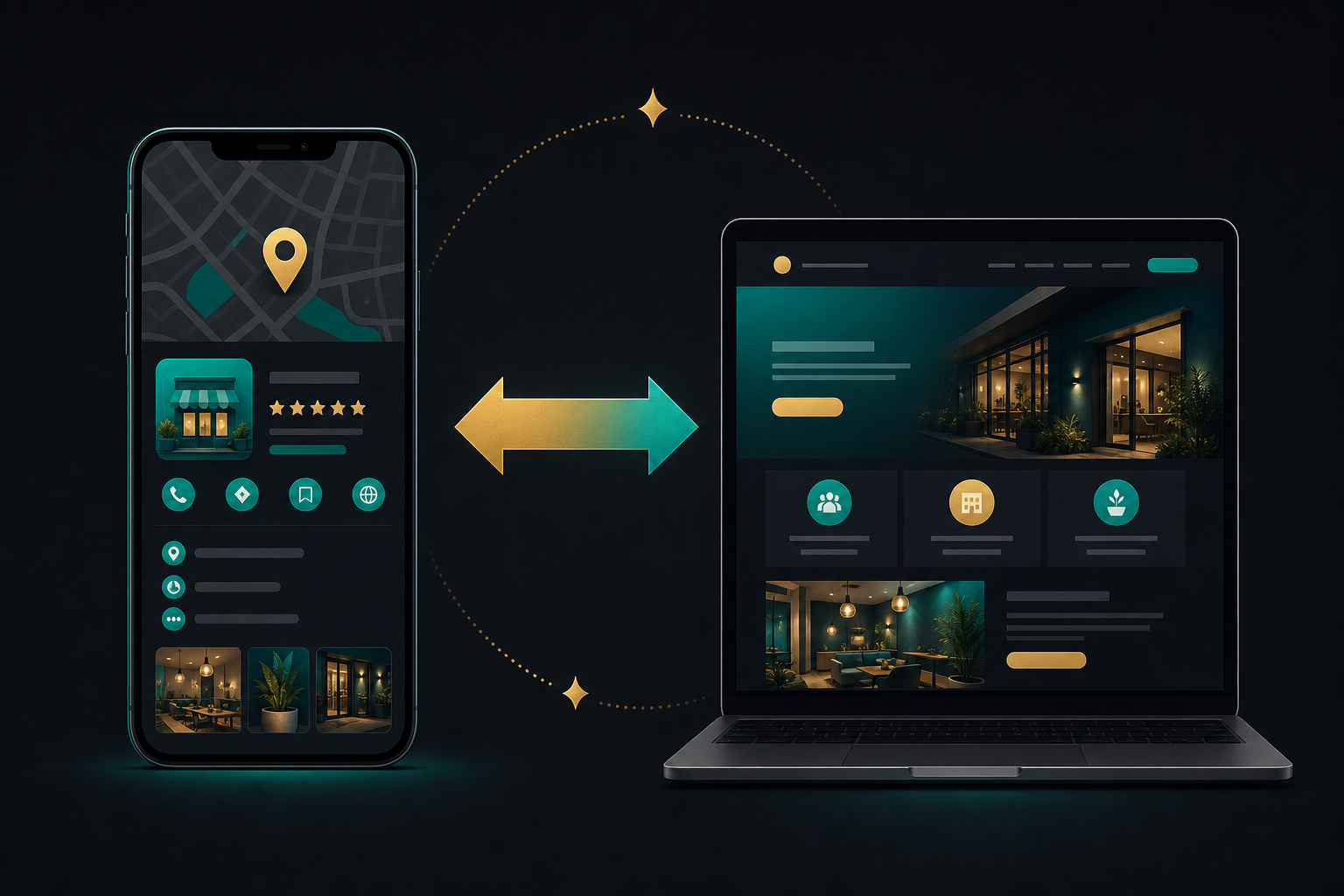
Behavioral signals are the most underrated Google Maps 3-pack ranking factor — and one of the hardest to fake (which is precisely why Google trusts them).
Google tracks:
- Click-through rate (CTR) from search results to your listing
- Direction requests — how many users tap "Get Directions"
- Clicks-to-call from the listing
- Photo views
- Website clicks from the listing
A listing that people repeatedly choose over competing listings sends a clear signal: users prefer this result. Google rewards that preference with higher placement.
How to improve engagement signals legitimately
- Post to your GBP weekly — Google Posts (offers, events, updates) keep your profile dynamic and give users more reasons to interact
- Add high-quality, recent photos — interior shots, team photos, before/after project shots all drive photo views
- Enable messaging — the GBP chat feature adds another click-engagement touchpoint
- Use a compelling business description that motivates the click in the first place
One client of ours — a Verdun-based renovation contractor — increased direction requests by 67% in 90 days simply by adding 24 job-site photos and posting weekly project updates. His 3-Pack position climbed from #6 (local finder) to a consistent #2.
What About the "Proximity" Factor — Can You Beat It?
Proximity is the one Google Maps ranking factor you largely can't control. If a searcher is standing in NDG and types "hardware store," Google will prioritize businesses physically closer to them. A business in Rosemont, no matter how well-optimized, has a proximity disadvantage for that specific search.
But proximity isn't destiny. Here's why:
- Service area businesses (plumbers, electricians, cleaners) can rank in multiple areas without a physical location there — by properly configuring service areas in GBP and building location-specific landing pages
- Relevance and prominence can override proximity when a business is significantly better-optimized than nearby competitors
- Searcher intent modifiers like "best," "affordable," or a specific neighbourhood name shift weight away from pure distance
We regularly rank clients in the 3-Pack for neighbourhoods where they have no physical presence — it requires a coordinated content and citation strategy, but it's absolutely achievable.
How Long Does It Take to See Results?
Based on our Montreal-market experience:
| Action Taken | Typical Time to Impact |
|---|---|
| GBP completeness audit + fix | 2–4 weeks |
| NAP citation cleanup | 4–8 weeks |
| Review velocity campaign | 4–12 weeks |
| Website local SEO pass | 6–12 weeks |
| Behavioral engagement lift | 8–16 weeks |
Combined, a full local SEO engagement typically produces measurable 3-Pack movement in 60–90 days for markets of low-to-medium competition (most Quebec cities outside downtown Montreal core). Highly competitive verticals (lawyers, HVAC, dentists in central Montreal) can take 4–6 months.

Frequently Asked Questions
What are the most important Google Maps 3-pack ranking factors?
Google officially cites relevance, distance, and prominence as its three core local ranking pillars. In practice, the highest-impact operational factors are: Google Business Profile completeness (especially category selection), NAP citation consistency, review volume and recency, website local optimization, and behavioral engagement signals like clicks and direction requests. Prioritize your GBP and reviews first — they produce the fastest visible results.
How many Google reviews do I need to rank in the 3-Pack?
There's no universal threshold, as the required volume depends entirely on your market and competition. In many smaller Quebec markets (Sherbrooke, Trois-Rivières, Saguenay), 30–50 reviews can be enough. In competitive Montreal niches like legal or dental, the top 3-Pack occupants often have 150–400+ reviews. Benchmark against whoever currently holds the top three spots in your target search, then set your goal slightly above the lowest count in that group.
Can I rank in the Google Maps 3-Pack without a physical storefront?
Yes — service area businesses (SABs) that operate from a home address or warehouse can absolutely rank in the 3-Pack. You'll need to hide your address in GBP (which is allowed and doesn't hurt rankings), define your service areas clearly within GBP, and build geo-targeted landing pages on your website for each city or neighbourhood you want to rank in. Many of our clients operate this way successfully across the Greater Montreal area.
Does my website's SEO affect my Google Maps ranking?
Indirectly but significantly, yes. Google uses your linked website to verify the relevance and legitimacy of your Business Profile. A website with LocalBusiness schema markup, a consistent NAP, city-specific content, and fast mobile load speeds reinforces every signal in your GBP. Conversely, a poorly optimized or slow website can act as a ceiling on your Maps ranking potential no matter how good your profile is.
How do I know if my NAP citations are hurting my ranking?
Run a citation audit using a tool like BrightLocal, Whitespark, or Semrush's Listing Management feature. Look for discrepancies in your business name spelling, address format (street vs. St. vs. Street), phone number (with or without country code), and website URL. In our Montreal client audits, suite numbers and French/English name variations are the most common inconsistency culprits. Fix discrepancies starting with the highest-authority directories (Google, Apple Maps, Yelp, Facebook) and work down.
Is it against Google's rules to ask customers for reviews?
No — Google explicitly permits businesses to ask customers for reviews, provided you don't offer incentives (discounts, gifts, cash) in exchange. The best practice is to ask verbally at the point of service, follow up with a direct review link via SMS or email, and make the process as frictionless as possible. Never use a review-gating tool that filters negative reviewers before they can post — this violates Google's policies and can result in a listing penalty.