Fast AI Website Build for Small Business | Ready in a Week
Quick Answer: A skilled agency using modern AI tools can build a professional, fully functional small business website in 5–7 business days — without sacrificing quality, SEO, or custom design. The speed comes from AI handling the repetitive layers of the build (copy drafts, code scaffolding, image sourcing, on-page SEO), freeing human experts to focus on strategy, brand alignment, and client-specific customization.
Is a "Website in a Week" Actually Possible for a Small Business?
The short answer is yes — and it's no longer a compromise.
Five years ago, a week-long website build meant a templated page with placeholder copy and a stock photo of someone shaking hands. Today, a fast AI website build for a small business looks completely different. We're talking about a site with:
- Custom visual identity applied to a professional framework
- SEO-structured page copy written specifically for your market
- Properly configured Google Business Profile integration
- Core Web Vitals optimized from day one
- Contact forms, booking widgets, and analytics — live and tested
At Mainstream Digicom, we've run this process with Montreal plumbers, Laval law offices, South Shore restaurants, and Westmount consultants. The one-week timeline is real. What changed is where the hours go.
What Does AI Actually Do to Speed Up a Website Build?
This is the question worth unpacking, because "AI-powered website" has become marketing noise. Let's be specific.
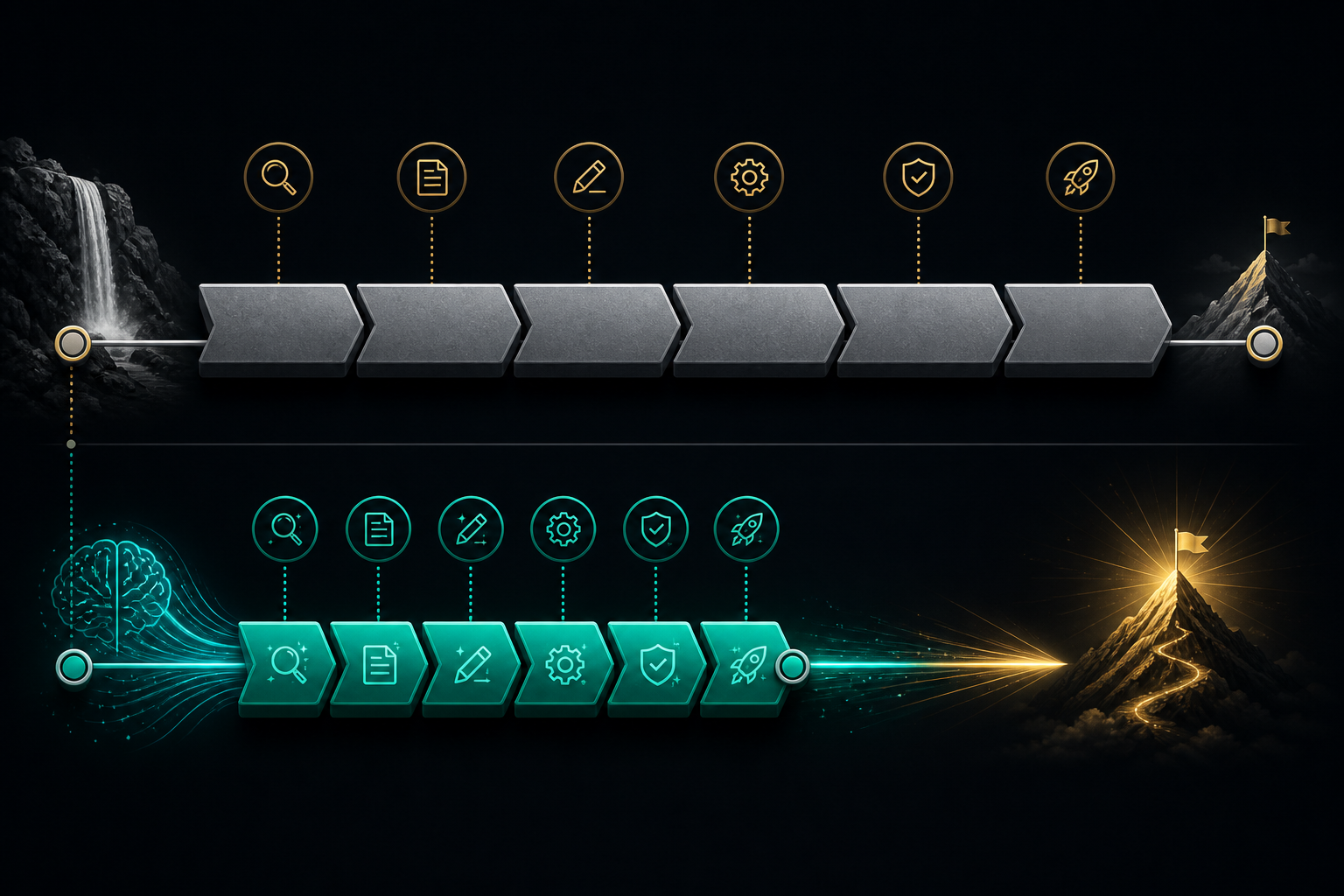
AI compresses the three slowest phases of any build
Traditional website projects stall in three places:
- Content creation — writing page copy, service descriptions, FAQs, meta tags
- Design iteration — back-and-forth mockup revisions
- Technical scaffolding — setting up CMS, configuring plugins, writing boilerplate code
In a conventional agency, these phases run sequentially and depend on human bandwidth at every step. AI collapses all three into a near-parallel workflow.
Here's what that looks like in practice at our studio:
Day 1 — Discovery & Brief (2–3 hours with the client)
We extract business context: services, service areas, differentiators, tone, competitors. This feeds every downstream AI task.
Day 1–2 — AI-Assisted Content Generation
Using the brief, AI tools generate first-draft copy for every page — Home, About, Services, Contact, plus three to five blog stubs for GEO (Generative Engine Optimization) purposes. A human editor then rewrites, tightens, and injects the brand voice. The AI does the 80%; the editor does the 20% that makes it actually good.
Day 2–3 — Design & Framework Build
Component libraries and AI-assisted design tools mean a skilled front-end developer isn't spending eight hours placing buttons and adjusting padding. The visual system is assembled in hours, not days.
Day 3–4 — SEO Configuration & Technical Integration
On-page SEO (title tags, schema markup, internal linking, image alt text) is largely automated and then reviewed. Local SEO signals — NAP consistency, Google Business Profile sync, local keyword targeting — are configured systematically.
Day 5 — QA, Client Review & Launch
Testing, revisions, DNS configuration, and go-live. The client sees a finished product, not a rough draft.
The total calendar time: five to seven business days. The total human hours: 25–40, concentrated on judgment and quality control rather than repetitive execution.
Won't Moving This Fast Mean a Generic, Cookie-Cutter Website?
This is the most common objection we hear — and it's a fair one, because it was true when speed meant templates.
The distinction today is between AI as a replacement for craft versus AI as an accelerant for craft. We operate firmly in the second category.
What stays 100% human in our process
- Brand strategy decisions — tone, positioning, what the hero headline actually says
- UX architecture — how a visitor moves from landing page to conversion
- Local market judgment — what a Mile-End café needs on its website is different from what a Brossard physiotherapy clinic needs
- Client relationship — the intake call, the feedback loop, the launch conversation
What AI handles (and why that's fine)
- Generating three headline options from a brief so a human can choose the best one
- Writing a 300-word service description that gets refined, not published verbatim
- Producing schema markup JSON so a developer doesn't write it by hand
- Suggesting internal link structures based on content hierarchy
The result is a site that feels custom because the decisions are custom. The execution is just faster.
A useful analogy: a chef using a food processor to chop vegetables isn't making a worse meal. They're spending more time on the plate presentation and the sauce.
How Does a Fast AI Website Build Compare to DIY Builders Like Squarespace or Wix?
Many small business owners come to us after spending weeks on a DIY website that never quite launched. This comparison matters.
| Factor | DIY Builder | Fast AI Agency Build |
|---|---|---|
| Time to launch | 3–8 weeks (typically) | 5–7 business days |
| SEO configuration | Basic, often misconfigured | Structured, schema-ready |
| Local SEO integration | Manual, inconsistent | Systematic GBP + NAP setup |
| Copy quality | Owner-written, unoptimized | AI-drafted, human-refined |
| Ongoing support | None | Agency relationship |
| Cost | Low upfront, high in time | Moderate, faster ROI |
The dirty secret of DIY website builders is that the platform is fast, but the owner becomes the bottleneck. Most small business owners aren't writers, designers, or SEO specialists. They spend 40 hours building something that still underperforms.
A fast AI website build for a small business through a qualified agency removes the owner from the execution entirely, getting them a better result faster — and letting them get back to running their business.

What Should a Small Business Expect to Get in a One-Week Build?
Not every one-week build is the same. Here's what a properly scoped fast AI website build should include at minimum — and what's realistic to expect.
Core deliverables in a 5–7 day project
Pages (typically 5–7):
- Home — with a clear value proposition and primary CTA
- About — brand story, trust signals, team
- Services — one page per core service, or a structured services overview
- Contact — form, address, map embed, phone
- Blog/Resources — minimum two published posts seeded for GEO visibility
Technical baseline:
- Mobile-responsive design (Google's mobile-first index makes this non-negotiable)
- Page speed optimized to hit a Lighthouse performance score above 85
- SSL certificate configured
- Google Analytics 4 + Google Search Console connected
- XML sitemap submitted
Local SEO foundation:
- Title tags and meta descriptions written for local keywords
- Schema markup: LocalBusiness, Service, and BreadcrumbList at minimum
- Google Business Profile audit and sync recommendations
What's NOT realistic in one week:
- A fully custom-coded design built from scratch (that's a 4–6 week project)
- E-commerce with a large product catalog
- Complex membership or booking systems requiring custom integrations
Being honest about scope is part of doing this well. A one-week build is a professional-grade launchpad, not a ten-year enterprise platform.
How Does This Affect SEO — Does Google Penalize Fast-Built Sites?
No. Google does not know or care how long your website took to build. It cares about what the website is when it crawls it.
What matters to Google:
- Content quality and relevance — is the page actually useful for the search query?
- Technical health — crawlability, speed, mobile responsiveness, structured data
- E-E-A-T signals — author credibility, business legitimacy, trustworthiness
- Local signals — consistent NAP, GBP alignment, local keyword coverage
A fast AI website build done properly checks all of these boxes better than a slow manual build done carelessly. We've seen AI-assisted sites built in a week outrank competitor sites that took months, simply because the fundamentals were configured correctly from day one.
One concrete example: a Montréal-area cleaning company we built in six business days ranked in the Google Maps 3-pack for their primary neighbourhood keyword within 11 weeks of launch. Their previous site had been live for three years without cracking the first page.
The speed of the build is irrelevant. The quality of the SEO work is everything.
Frequently Asked Questions
How much does a fast AI website build for a small business typically cost?
In the Montreal market, a professionally built AI-assisted small business website ranges from approximately $2,500 to $6,500 CAD depending on page count, complexity, and whether local SEO setup is included. This is significantly less than a traditional custom build ($8,000–$20,000+) while delivering comparable results for most small businesses. The cost savings come from AI reducing labour hours in execution, not from cutting the quality of strategic and creative work.
Will I own my website after a one-week AI build?
You should — always confirm this before signing any agreement. At Mainstream Digicom, clients own their domain, their hosting account, and all website files outright. You're paying for the build, not a subscription to access your own content. Be cautious of any agency that hosts your site on a proprietary platform where they retain control if you leave.
What information do I need to provide to get started?
The more context you can provide upfront, the better the output. You'll need: your core services and service areas, your target customer (be specific), 3–5 competitor URLs, your brand preferences (colours, tone), any existing logo or visual assets, and your primary business phone and address. A 2–3 hour discovery session at the start of the project covers most of this systematically.
Can AI-generated website copy hurt my SEO rankings?
AI-generated copy that is published verbatim, unedited, and thin (under 300 words per page) can hurt your rankings. AI-assisted copy that is reviewed, refined, fact-checked, and written to serve a specific user intent is indistinguishable from human-written copy to Google — and often better structured for SEO than first-draft human writing. The key word is "assisted," not "replaced."
How is a one-week AI website build different from using a website builder myself?
A DIY builder gives you a tool; a professional AI-assisted build gives you a finished product. The platform speed is similar, but the expertise embedded in the decisions — keyword targeting, conversion architecture, technical SEO configuration, local search setup — is what DIY tools can't provide. Most business owners who try DIY builders spend more cumulative hours than a one-week professional project would take, and still end up with a site that underperforms.
What happens after the website launches?
Launch is the beginning, not the end. A well-built site needs ongoing content (for GEO and SEO), Google Business Profile management, and periodic technical audits. We offer monthly maintenance and growth packages that include AI-assisted blog content, local SEO monitoring, and performance reporting. Businesses that treat their website as a living asset consistently outperform those that launch and walk away.