This ChatGPT Secret Could Make Your Business Invisible (Don t Let It Happen)

Sarah thought she had it all figured out. Her artisanal bakery in downtown Portland was crushing it on Google – first page rankings for “best sourdough Portland,” thousands of monthly visitors, and a steady stream of customers walking through her doors. Then something strange started happening in late 2024.
Regular customers began mentioning they’d heard about other bakeries from “ChatGPT recommendations.” Sales started dipping. When Sarah asked her tech-savvy nephew to search for “best bakery near downtown Portland” in ChatGPT, her heart sank. Three competitors were mentioned by name, complete with glowing descriptions and specific menu recommendations. Her bakery? Nowhere to be found.
Sarah’s story isn’t unique. Across industries, businesses are discovering that their Google dominance means nothing if they’re invisible to AI search. While they were busy optimizing for traditional search engines, a new player quietly changed the game. ChatGPT search launched officially on October 31, 2024, and it’s already reshaping how people discover businesses, products, and services.
Here’s the uncomfortable truth: if you can’t ChatGPT index website content properly, you’re essentially invisible to a growing segment of consumers who prefer conversational AI over traditional search. Recent data shows that 10% of Vercel’s new signups now come directly from ChatGPT interactions – not Google, not social media, but AI-powered conversations.
This isn’t some distant future scenario. It’s happening right now, and businesses that don’t adapt are getting left behind faster than you can say “artificial intelligence.” But here’s the good news: you’re not too late. In fact, you’re still early enough to gain a significant competitive advantage.
In this comprehensive guide, you’ll discover exactly how to ChatGPT index website content so your business shows up when potential customers ask AI for recommendations. We’ll cover everything from the technical setup that takes minutes to implement, to the content strategies that make AI fall in love with your brand. By the end, you’ll have a complete roadmap to dominate the AI search landscape before your competitors even realize what’s happening.
Why Your Google Rankings Don’t Matter Anymore (Well, Not Entirely)
Remember when everyone said voice search was going to revolutionize everything? We all dutifully optimized for “near me” queries and started writing in question format, waiting for the voice search apocalypse that never quite materialized. Well, ChatGPT actually did what voice search promised to do – and it happened so quietly that most businesses missed it entirely.
The numbers don’t lie. While traditional search still dominates overall web traffic, AI-powered search is growing at an unprecedented rate. Companies like Vercel report that 10% of their new customer acquisitions now come directly from ChatGPT interactions. That’s not 10% of their search traffic – that’s 10% of their entire customer base discovering them through AI conversations.
But here’s where it gets interesting (and slightly terrifying for unprepared businesses): ChatGPT doesn’t just regurgitate search results like voice assistants do. It synthesizes information, makes recommendations, and provides context in ways that feel genuinely helpful. When someone asks ChatGPT “What’s the best project management tool for a small marketing agency?”, they don’t get a list of blue links. They get a thoughtful analysis comparing features, pricing, and use cases, often mentioning specific brands by name.
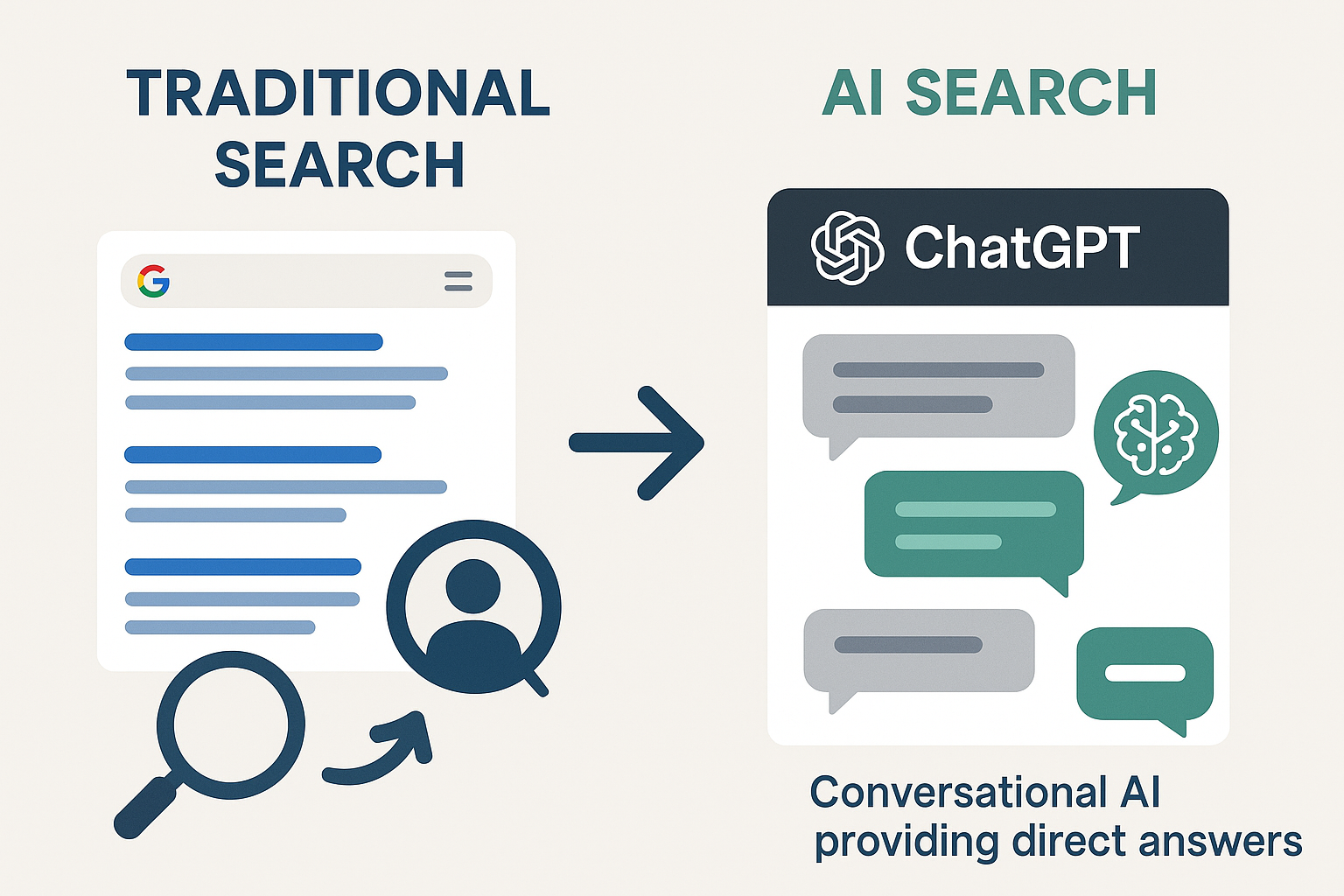
The shift is so fundamental that it’s changing how people think about information discovery. Instead of typing keywords and sifting through results, users are having natural conversations with AI. They’re asking follow-up questions, requesting clarifications, and getting personalized recommendations based on their specific needs and context.
This conversational approach creates both an enormous opportunity and a significant challenge. The opportunity? When ChatGPT recommends your business, it often comes with detailed explanations of why you’re the right choice, creating pre-qualified leads who arrive already convinced of your value. The challenge? If you’re not visible to ChatGPT, you might as well not exist for this growing segment of potential customers.
What makes this particularly crucial is the demographic shift we’re seeing. Early adopters of ChatGPT search tend to be tech-savvy professionals, decision-makers, and younger consumers – exactly the audience most businesses want to reach. These aren’t casual browsers; they’re people actively seeking solutions and ready to make purchasing decisions.
The traditional SEO playbook isn’t obsolete, but it’s incomplete. You still need to rank well on Google because ChatGPT often pulls information from search engines. However, the way that information gets processed, synthesized, and presented to users is entirely different. This means you need to optimize not just for search engine crawlers, but for AI understanding and recommendation algorithms.
Think of it this way: if traditional SEO was about getting invited to the party, AI optimization is about being the person everyone wants to talk to once you’re there. It’s not enough to show up; you need to be memorable, helpful, and genuinely valuable in ways that AI can recognize and articulate to users.
Meet the Bots That Decide Your Digital Fate
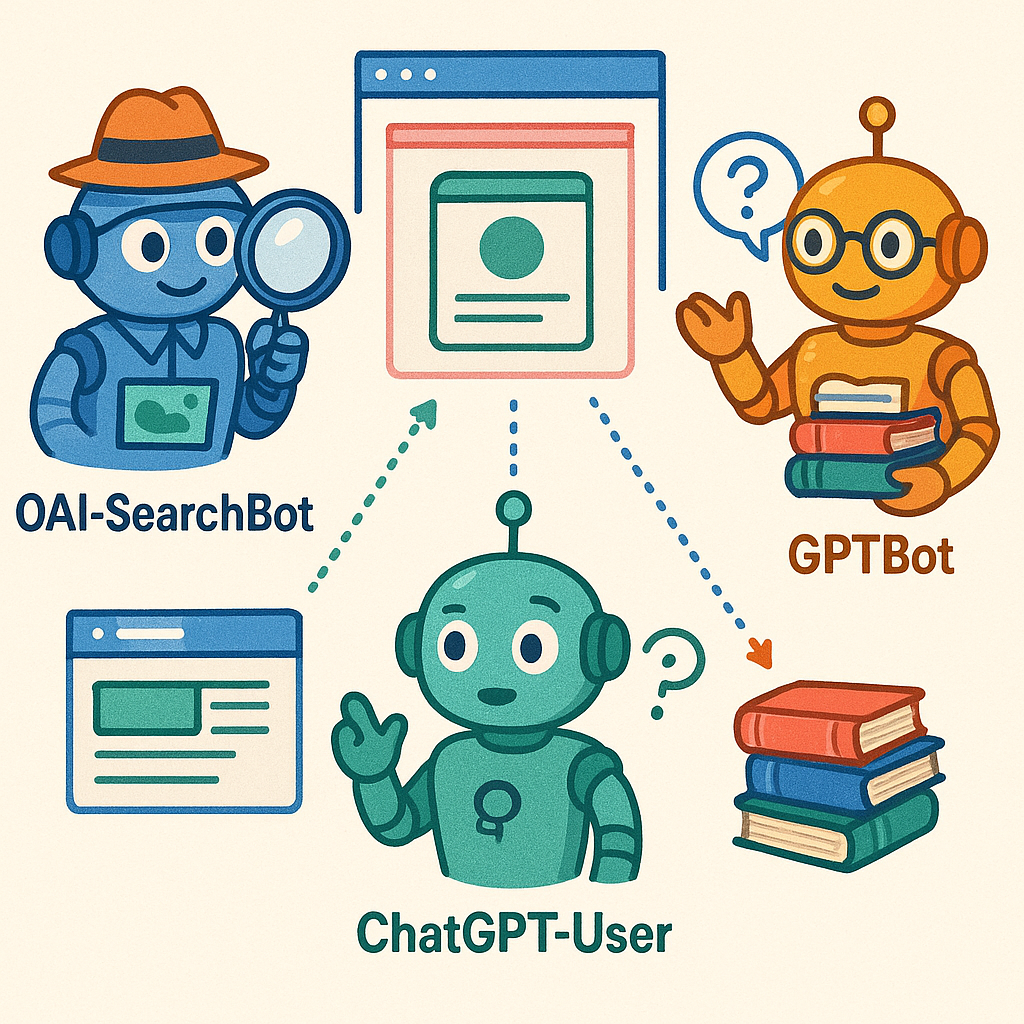
If you want to ChatGPT index website content successfully, you need to understand the three digital gatekeepers that determine whether your business gets mentioned in AI conversations or remains invisible. Think of these bots like bouncers at an exclusive club – except instead of checking IDs, they’re evaluating whether your content deserves a spot in the AI knowledge base.
OAI-SearchBot: The Primary Indexing Detective
Meet OAI-SearchBot, the main character in your ChatGPT visibility story. This is the bot that’s actively crawling the web right now, deciding which websites deserve to be included in ChatGPT’s knowledge base for search functionality. Think of it as a digital detective with an insatiable curiosity about what makes your website valuable.
OAI-SearchBot doesn’t just randomly browse the internet like a bored teenager. It’s methodical, intelligent, and surprisingly picky about what it considers worth indexing. The bot evaluates content quality, relevance, authority, and user value – all factors that determine whether your business will show up when someone asks ChatGPT for recommendations in your industry.
What makes OAI-SearchBot particularly interesting is its relationship with traditional search engines. While it operates independently, it often cross-references information with established search indexes, particularly Bing’s database. This means your traditional SEO efforts aren’t wasted – they’re actually foundational to your AI visibility strategy.
The bot visits websites regularly, looking for fresh content, updated information, and signals that indicate a site is actively maintained and valuable to users. It pays attention to technical factors like site speed and mobile responsiveness, but it’s equally interested in content depth, expertise demonstration, and user engagement signals.
ChatGPT-User: The Real-Time Information Gatherer
While OAI-SearchBot handles the bulk indexing work, ChatGPT-User is the bot that springs into action when someone asks ChatGPT a question requiring current information. This is your real-time visibility lifeline – the bot that can surface your content even if you haven’t been fully indexed yet.
ChatGPT-User is like that incredibly efficient research assistant who can find exactly what they need in seconds. When a user asks about recent developments, current pricing, or up-to-date information, this bot quickly scans relevant websites to provide accurate, timely responses.
This bot’s behavior is particularly important for businesses in rapidly changing industries. If you’re in technology, finance, healthcare, or any field where information becomes outdated quickly, ChatGPT-User might be your primary pathway to AI visibility. It’s constantly evaluating whether your content provides the most current and accurate information available.
The key to appealing to ChatGPT-User is maintaining fresh, accurate content that clearly indicates when it was last updated. This bot values recency and accuracy above almost everything else, making it crucial for businesses that want to be cited for current information and trends.
GPTBot: The Training Data Collector
Here’s where things get interesting – and slightly controversial. GPTBot is the bot responsible for collecting data that might be used to train future AI models. Unlike the other two bots, GPTBot isn’t directly involved in making your content visible in ChatGPT search results. Instead, it’s building the knowledge base that future AI systems will draw from.
GPTBot is like that friend who remembers everything you’ve ever said and somehow manages to bring it up in conversations months later. It’s methodically cataloging web content to improve AI understanding of language, context, and domain-specific knowledge.
Many website owners choose to block GPTBot because they don’t want their content used for AI training purposes. This is a legitimate concern, especially for businesses with proprietary information or unique methodologies. However, blocking GPTBot doesn’t affect your ability to appear in ChatGPT search results – that’s handled by the other two bots.
The decision to allow or block GPTBot often comes down to your philosophy about AI development and data usage. Some businesses see it as contributing to technological advancement, while others prefer to maintain tighter control over how their content is used. Both approaches are valid, and the choice won’t impact your immediate ChatGPT visibility.
How These Bots Work Together
Understanding how these three bots interact is crucial for developing an effective ChatGPT optimization strategy. OAI-SearchBot builds the foundation by indexing quality content, ChatGPT-User provides real-time updates and current information, and GPTBot contributes to the overall intelligence of the system.
The most successful businesses in AI search are those that appeal to all three bots simultaneously. They maintain high-quality, authoritative content that OAI-SearchBot wants to index, keep information current and accurate for ChatGPT-User, and provide valuable insights that contribute to the broader AI knowledge base through GPTBot.
This multi-bot approach explains why some websites appear consistently in ChatGPT responses while others remain invisible despite having good traditional SEO. It’s not enough to optimize for one aspect – you need a holistic strategy that addresses the different ways AI systems evaluate and utilize web content.
Step 1: How to Roll Out the Red Carpet for AI Crawlers
Now that you understand the three bots that control your ChatGPT destiny, let’s talk about the first practical step to ChatGPT index website content: configuring your robots.txt file properly. If the bots are bouncers at an exclusive club, think of robots.txt as the guest list that determines who gets in and who gets turned away at the door.
Here’s a story that perfectly illustrates why this matters: I once worked with a client who couldn’t understand why their competitors were showing up in ChatGPT responses while their superior content remained invisible. After some investigation, we discovered they had accidentally blocked all AI crawlers in their robots.txt file during a security update six months earlier. One small configuration change, and suddenly they were getting mentioned in AI conversations within weeks.
Understanding Robots.txt in Plain English
Before we dive into the technical details, let’s demystify what robots.txt actually does. Imagine your website is a house, and various bots are visitors who want to come inside and look around. The robots.txt file is essentially a sign on your front door that tells each visitor which rooms they can enter and which areas are off-limits.
By default, if you don’t have a robots.txt file (or if it’s completely empty), you’re essentially putting up a “Welcome, everyone!” sign. All bots – including the three OpenAI bots we discussed – can freely explore your entire website. For most businesses, this is exactly what you want for AI visibility.
However, many websites have robots.txt files that were configured years ago for traditional SEO purposes, often without considering AI crawlers. These files might inadvertently block the very bots you now want to attract, creating an invisible barrier between your content and AI search results.
The Rank Math Advantage for Robots.txt Management
If you’re using WordPress (and statistically, there’s a good chance you are), Rank Math makes robots.txt management incredibly straightforward. Instead of fumbling with FTP clients or trying to edit files directly on your server, you can manage everything from your WordPress dashboard.
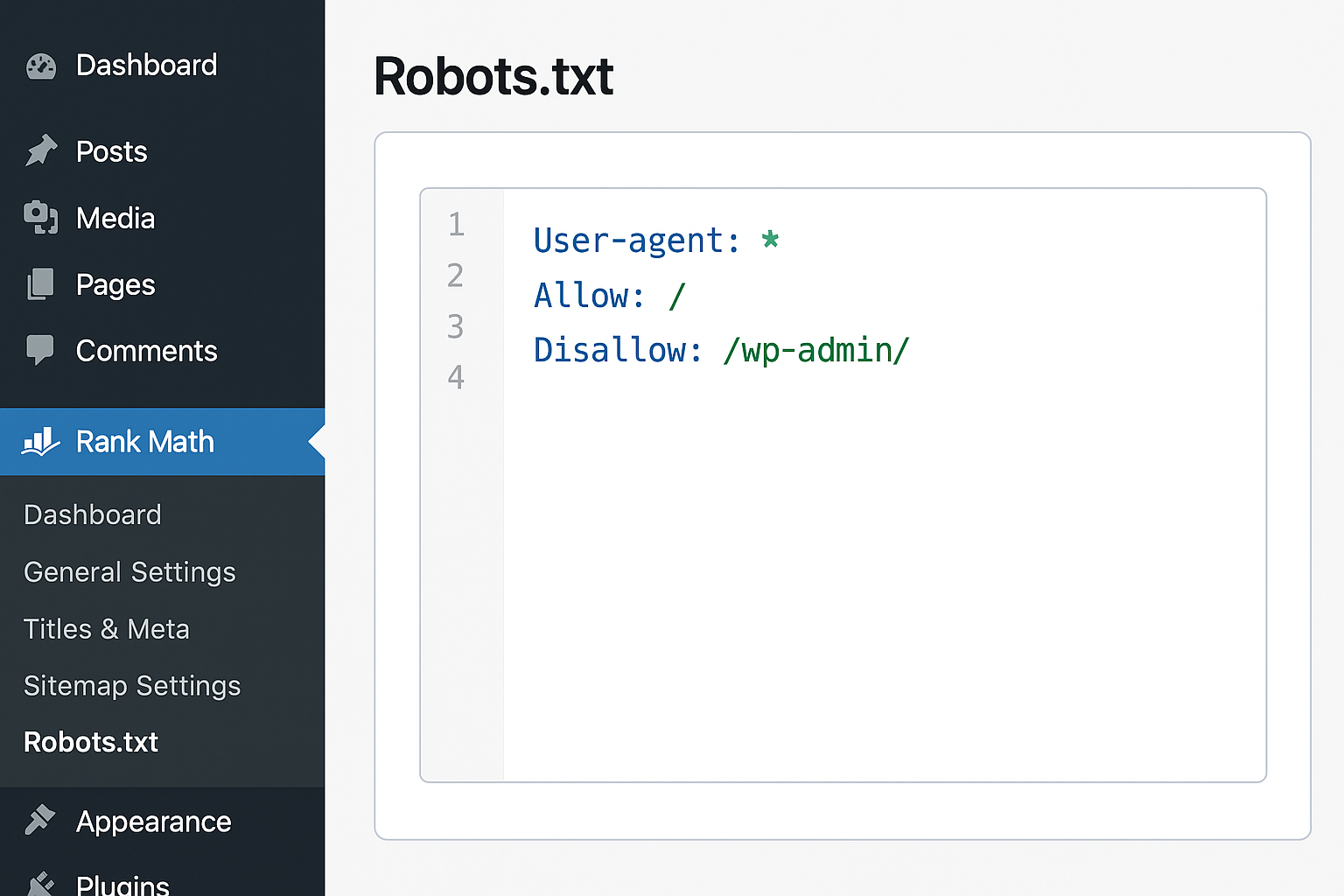
To access your robots.txt file through Rank Math, simply hover over “Rank Math SEO” in your WordPress admin menu and select “General Settings.” From there, you’ll see an “Edit Robots.txt” option that opens a user-friendly editor where you can make changes without risking syntax errors or accidentally breaking your site.
The default Rank Math robots.txt configuration is actually quite intelligent. It typically includes directives that allow all bots to access your front-end content while preventing them from indexing administrative areas, login pages, and other backend functionality that shouldn’t appear in search results anyway.
Configuring for OpenAI Bot Access
Here’s the crucial part: ensuring that all three OpenAI bots can access your content. The good news is that if you haven’t specifically blocked these bots, they’re already allowed by default. The robots.txt standard operates on a “allow unless explicitly denied” basis.
Your robots.txt file should include these basic directives:
Plain Text
User-agent: * Allow: / Disallow: /wp-admin/ Disallow: /wp-login.php
This configuration welcomes all bots (including OAI-SearchBot, ChatGPT-User, and GPTBot) while keeping them out of your WordPress administrative areas. The asterisk (*) is a wildcard that applies to all user agents, making it unnecessary to list each OpenAI bot individually.
When You Might Want to Block GPTBot
Remember our earlier discussion about GPTBot being responsible for training data collection? Some businesses prefer to block this specific bot while still allowing the other two that directly impact ChatGPT search visibility. If you want to take this approach, you would add these lines to your robots.txt:
Plain Text
User-agent: GPTBot Disallow: /
This blocks GPTBot specifically while still allowing OAI-SearchBot and ChatGPT-User to access your content. Your website can still appear in ChatGPT search results, but your content won’t be used for training future AI models.
Common Robots.txt Mistakes That Kill AI Visibility
I’ve seen businesses accidentally sabotage their AI visibility with well-intentioned but misguided robots.txt configurations. Here are the most common mistakes to avoid:
The Overzealous Security Approach: Some businesses block all bots except Google and Bing, not realizing they’re also blocking OpenAI crawlers. This approach made sense in 2020 but is counterproductive in the AI era.
The Outdated SEO Configuration: Many robots.txt files were last updated years ago and include blanket blocks on bots that were considered problematic at the time but are now essential for AI visibility.
The Copy-Paste Disaster: Copying robots.txt configurations from other websites without understanding what each directive does can lead to accidentally blocking important crawlers.
Testing Your Robots.txt Configuration
After configuring your robots.txt file, it’s crucial to verify that OpenAI bots can actually access your content. You can use online robots.txt testing tools to simulate how different user agents will interpret your directives.
Simply enter your website URL and test for “OAI-SearchBot” to ensure it’s allowed to crawl your site. If the test shows that the bot is blocked, you’ll need to review your robots.txt configuration and remove any directives that might be preventing access.
The beauty of robots.txt changes is that they take effect immediately. Unlike many SEO modifications that require weeks or months to show results, properly configuring your robots.txt file can start improving your AI visibility within days as the bots begin their next crawling cycle.
This first step might seem simple, but it’s foundational to everything else we’ll discuss. You can have the most AI-optimized content in the world, but if the bots can’t access it due to robots.txt restrictions, you’ll remain invisible in ChatGPT responses. Get this right, and you’ve cleared the first major hurdle to AI search success.
Step 2: Why Bing Became Your Best Friend Overnight
Here’s a plot twist that nobody saw coming: Bing, the search engine that everyone loved to joke about, suddenly became one of the most important factors in your business’s AI visibility. While we were all obsessing over Google rankings, Microsoft quietly positioned Bing as the primary data source for ChatGPT search results.
Bing went from being the search engine nobody talked about to the one everyone needs. It’s like discovering that the quiet kid from high school became a billionaire – suddenly, everyone wants to be their friend. The relationship between ChatGPT and Bing isn’t just a partnership; it’s a fundamental dependency that makes Bing optimization essential for AI visibility.
The ChatGPT-Bing Connection Explained
When ChatGPT needs current information to answer user queries, it doesn’t maintain its own massive web index like Google does. Instead, it leverages Bing’s search infrastructure to find relevant, up-to-date content. This means that if your website isn’t properly indexed by Bing, you’re essentially invisible to ChatGPT’s real-time search capabilities.
This dependency creates both an opportunity and a responsibility. The opportunity is that Bing’s index is generally less competitive than Google’s, making it potentially easier to achieve visibility. The responsibility is that you can no longer afford to ignore Bing if you want to succeed in the AI search landscape.
Recent evidence suggests that ChatGPT may also pull from Google’s index in some cases, but Bing remains the primary source. This dual-source approach means that while Google optimization is still valuable, Bing optimization has become absolutely critical for businesses that want to ChatGPT index website content effectively.
Setting Up Bing Webmaster Tools: Your Gateway to AI Visibility
The first step in your Bing optimization journey is setting up Bing Webmaster Tools. Think of this as your mission control center for monitoring and improving your Bing visibility, which directly impacts your ChatGPT presence.
If you already have Google Search Console set up (and you should), the process becomes remarkably simple. Bing allows you to import your verified sites directly from Google Search Console, saving you time and ensuring consistency across platforms. This integration reflects Microsoft’s pragmatic approach to competing with Google – they make it easy for you to optimize for both platforms simultaneously.
To get started, visit the Bing Webmaster Tools website and sign in with a Microsoft account. If you don’t have one, creating an account takes just a few minutes. Once you’re logged in, you’ll see options to add your website either by importing from Google Search Console or by manually adding your site URL.
The Import Method: Leveraging Your Google Setup
If you’ve already verified your website with Google Search Console, the import method is by far the most efficient approach. Simply select “Import from Google Search Console” and authorize Bing to access your Google data. This process typically takes just a few minutes and automatically imports your site verification, sitemap submissions, and basic configuration settings.
The beauty of this approach is that it maintains consistency between your Google and Bing optimization efforts. Any sitemaps you’ve submitted to Google will automatically be submitted to Bing, and your site verification status transfers seamlessly. This integration eliminates the common problem of optimizing for one search engine while neglecting the other.
Manual Site Addition: When You Need Full Control
If you prefer to set up Bing Webmaster Tools manually or don’t have Google Search Console configured, the manual process is straightforward. Simply enter your website URL and click “Add.” Bing will then provide several verification methods to confirm that you own the website.
The HTML meta tag method is often the most convenient, especially if you’re using Rank Math. Bing provides a unique verification code that you can add to your website’s header through Rank Math’s Webmaster Tools section. This approach doesn’t require FTP access or file uploads, making it accessible to users with limited technical expertise.
Once you’ve added the verification code through Rank Math and saved your changes, return to Bing Webmaster Tools and click “Verify.” The verification process typically completes within minutes, giving you immediate access to your site’s Bing performance data and optimization tools.
Sitemap Submission: Your Content Discovery Accelerator
After verifying your website, the next crucial step is submitting your XML sitemap to Bing. Your sitemap is essentially a roadmap that tells search engines about all the important pages on your website, helping them discover and index your content more efficiently.
If you’re using Rank Math, your sitemap is automatically generated and kept up-to-date as you add new content. You can find your sitemap URL in the Rank Math sitemap settings – it typically follows the format “yourwebsite.com/sitemap_index.xml.” This master sitemap contains links to individual sitemaps for different content types, creating a comprehensive overview of your site structure.
In Bing Webmaster Tools, navigate to the “Sitemaps” section and paste your sitemap URL. Click “Submit” and Bing will begin processing your sitemap, discovering pages that might not have been found through normal crawling. This process can significantly accelerate your indexing timeline, potentially getting your content into ChatGPT’s knowledge base weeks or months faster than waiting for natural discovery.
Understanding Bing’s Unique Ranking Factors
While Bing and Google share many ranking factors, Bing has some unique preferences that can impact your ChatGPT visibility. Understanding these differences allows you to optimize specifically for Bing without compromising your Google performance.
Bing tends to place more emphasis on exact keyword matches and traditional SEO signals compared to Google’s more sophisticated semantic understanding. This means that including your target keywords in titles, headings, and meta descriptions can have a more direct impact on your Bing rankings than it might on Google.
Social signals also carry more weight in Bing’s algorithm. Shares, likes, and engagement on social media platforms can positively influence your Bing rankings, which in turn affects your likelihood of being cited in ChatGPT responses. This creates an interesting connection between social media marketing and AI visibility that many businesses haven’t yet recognized.
Bing also shows a preference for websites with strong domain authority and established credibility. This means that building high-quality backlinks and maintaining consistent, authoritative content becomes even more important for AI visibility than it was for traditional SEO.
Monitoring Your Bing Performance
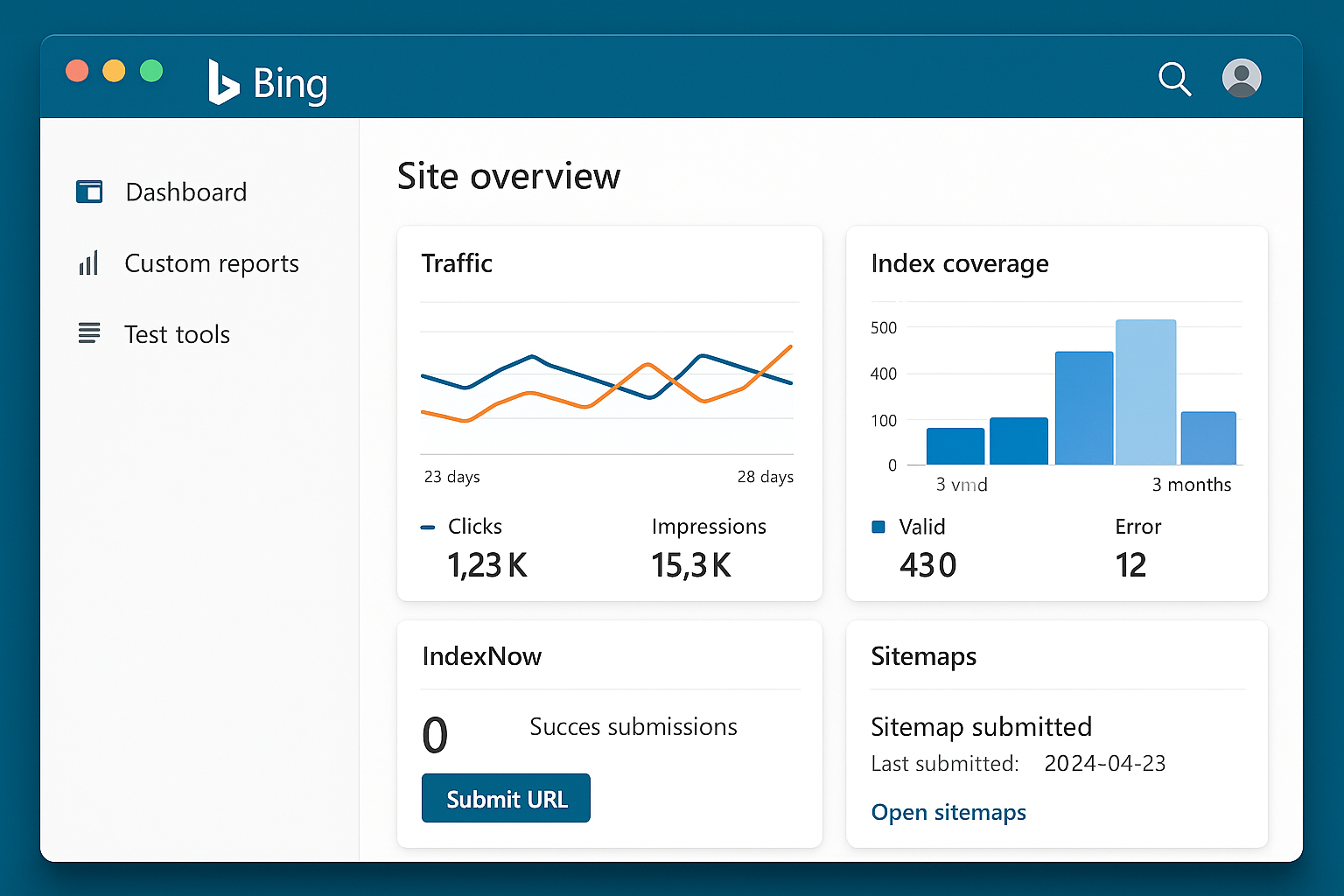
Once your site is set up in Bing Webmaster Tools, you’ll have access to valuable data about how Bing perceives and indexes your content. The dashboard provides insights into crawl errors, indexing status, and search performance that can help you identify and fix issues that might be limiting your AI visibility.
Pay particular attention to the “Index Explorer” section, which shows which of your pages Bing has successfully indexed. Pages that aren’t indexed by Bing are unlikely to appear in ChatGPT responses, making this data crucial for understanding your AI visibility potential.
The “Search Performance” reports show which queries are driving traffic from Bing, providing insights into how users are finding your content through traditional search. While ChatGPT queries are conversational rather than keyword-based, understanding your Bing search performance can help you identify content gaps and optimization opportunities that will benefit both traditional and AI search visibility.
The Compound Effect of Bing Optimization
What makes Bing optimization particularly powerful for AI visibility is the compound effect it creates. As your Bing rankings improve, your content becomes more likely to be surfaced by ChatGPT’s real-time search capabilities. This increased AI visibility can drive more traffic and engagement, which further improves your Bing rankings, creating a positive feedback loop.
This virtuous cycle explains why some businesses see dramatic improvements in ChatGPT mentions after focusing on Bing optimization. It’s not just about getting indexed – it’s about building the authority and relevance signals that make AI systems confident in recommending your business to users.
The businesses that will dominate AI search in the coming years are those that recognize this Bing-ChatGPT connection and optimize accordingly. While your competitors are still focused exclusively on Google, you can gain a significant advantage by mastering the search engine that actually powers AI recommendations.
Step 3: The File That Makes AI Fall in Love With Your Website
Here’s where things get really interesting – and where you can gain a massive competitive advantage over businesses that haven’t discovered this secret yet. While everyone else is still figuring out basic ChatGPT optimization, you’re about to learn about LLMS.txt, the emerging standard that’s like giving AI a cheat sheet about your website.
LLMS.txt is the file that makes AI systems immediately understand what your website is about, what makes you unique, and why you deserve to be mentioned in conversations with potential customers. It’s like having a perfectly crafted elevator pitch that’s specifically designed for artificial intelligence rather than humans.
The businesses implementing LLMS.txt right now are positioning themselves as early adopters of a standard that will likely become as important as robots.txt or sitemaps. While your competitors are still trying to figure out why they’re not showing up in ChatGPT responses, you’ll be systematically optimizing for AI visibility in ways they haven’t even considered.
Understanding LLMS.txt in Simple Terms
Think of LLMS.txt as a friendly introduction letter that you leave for AI systems visiting your website. Instead of forcing them to crawl through hundreds of pages to understand what you do, who you serve, and what makes you special, you provide a concise, structured summary that highlights your most important content and value propositions.
The file follows a specific format that large language models can easily parse and understand. It includes your most important pages, key information about your business, and context that helps AI systems make informed decisions about when and how to recommend you to users.
What makes LLMS.txt particularly powerful is that it’s designed specifically for the way AI systems process and understand information. While traditional SEO focuses on keyword optimization and link building, LLMS.txt optimization is about clarity, context, and relevance from an AI perspective.
The Rank Math Implementation Advantage
If you’re using Rank Math, implementing LLMS.txt becomes incredibly straightforward – even the free version includes this functionality. Instead of manually creating and uploading files to your server, you can enable and configure LLMS.txt directly from your WordPress dashboard.
To activate this feature, navigate to your Rank Math dashboard and scroll down to find the “LLMS.txt” module. Simply toggle it on, and Rank Math automatically creates the file structure and makes it accessible at yourwebsite.com/llms.txt. This automated approach eliminates the technical barriers that prevent many businesses from implementing this optimization.
Once activated, you can access the LLMS.txt editor through Rank Math’s general settings. The interface is user-friendly and includes helpful guidance about what information to include and how to structure it for maximum AI comprehension.
Configuring Your LLMS.txt for Maximum Impact
The default LLMS.txt configuration that Rank Math creates is a good starting point, but customizing it for your specific business can dramatically improve your AI visibility. The file should include your most important pages, but more importantly, it should provide context about what makes those pages valuable.
Start by selecting the post types that represent your core content. If you’re a service-based business, this might include your main service pages and case studies. For e-commerce sites, it could be your key product categories and best-selling items. The goal is to highlight the content that best represents your expertise and value proposition.
The “additional content” area is where you can really make your LLMS.txt shine. This is your opportunity to provide context that helps AI systems understand not just what you do, but why you’re uniquely qualified to do it. Include information about your expertise, your target audience, and what sets you apart from competitors.
For example, instead of just listing your “About” page, you might include context like: “About page detailing 15 years of experience in sustainable architecture, with focus on LEED-certified commercial buildings and energy-efficient design solutions for mid-sized businesses.”
Best Practices for LLMS.txt Content
The most effective LLMS.txt files strike a balance between comprehensiveness and conciseness. You want to provide enough information for AI systems to understand your value proposition, but not so much that the important details get lost in unnecessary text.
Focus on your most important and frequently updated content. AI systems value recency and relevance, so including pages that you regularly update with fresh information can improve your chances of being cited for current topics and trends in your industry.
Include clear descriptions of what each page contains and why it’s valuable. Instead of just listing URLs, provide context that helps AI systems understand when and why they should reference your content. This descriptive approach makes it more likely that your pages will be surfaced for relevant queries.
Consider your target audience when crafting descriptions. If you serve multiple customer segments, make sure your LLMS.txt reflects the different ways your content might be valuable to different types of users. This comprehensive approach increases the likelihood that AI systems will recommend you for a broader range of queries.
The Competitive Advantage of Early Adoption
Here’s what most businesses don’t realize: LLMS.txt is still in the early adoption phase. While major companies like Vercel are already seeing significant results (remember that 10% of their signups now come from ChatGPT), most small and medium-sized businesses haven’t even heard of this optimization technique.
This creates an enormous opportunity for businesses that implement LLMS.txt now. You’re essentially optimizing for a ranking factor that your competitors don’t know exists, giving you a significant head start in the AI visibility race.
The businesses that will dominate AI search in the next few years are those that recognize emerging standards like LLMS.txt and implement them before they become common knowledge. By the time everyone else catches on, you’ll already have months or years of optimization advantage.
Technical Implementation Without the Headaches
For businesses not using Rank Math, implementing LLMS.txt requires uploading a text file to your website’s root directory. While this isn’t technically complex, it does require FTP access and basic file management skills that many business owners prefer to avoid.
The file structure itself is straightforward, following a format that includes your website URL, a brief description, and a list of important pages with context. However, maintaining and updating this file manually can become time-consuming, especially for businesses with frequently changing content.
This is where Rank Math’s automated approach provides significant value. The plugin not only creates and maintains the file structure but also keeps it updated as you add new content and make changes to your website. This automation ensures that your LLMS.txt file always reflects your current content and priorities.
Measuring LLMS.txt Impact
Unlike traditional SEO metrics, measuring the impact of LLMS.txt optimization requires a different approach. You won’t see immediate changes in Google Analytics or traditional search rankings. Instead, you’ll need to monitor mentions in AI conversations and track referral traffic from AI-powered platforms.
Start by regularly testing how your business appears in ChatGPT responses for relevant queries. Keep notes about which aspects of your business are mentioned and how accurately AI systems describe your services or products. Improvements in these areas often indicate that your LLMS.txt optimization is working.
Monitor your website analytics for unusual traffic patterns or referral sources that might indicate AI-driven visits. While ChatGPT doesn’t always provide direct links, users often visit websites after receiving AI recommendations, creating trackable traffic patterns.
The long-term impact of LLMS.txt optimization often compounds over time. As AI systems become more familiar with your content and value proposition, they become more likely to recommend you for relevant queries, creating a positive feedback loop that can significantly boost your AI visibility.
Future-Proofing Your AI Strategy
LLMS.txt represents more than just another optimization technique – it’s a glimpse into the future of how businesses will communicate with AI systems. As artificial intelligence becomes more sophisticated and prevalent, the ability to clearly articulate your value proposition to AI systems will become increasingly important.
Businesses that master LLMS.txt optimization now are developing skills and insights that will be crucial as AI search continues to evolve. You’re not just optimizing for current AI systems; you’re building the foundation for success in an increasingly AI-driven digital landscape.
The file format may evolve and new standards may emerge, but the fundamental principle remains the same: businesses that can effectively communicate their value to AI systems will have a significant advantage over those that rely solely on traditional optimization techniques.
Write Like You’re Talking to Your Smartest Friend
Here’s the counterintuitive truth about creating content that AI systems love: stop writing like a robot if you want robots to like you. The biggest mistake businesses make when trying to ChatGPT index website content is assuming that AI systems prefer formal, keyword-stuffed, corporate-speak content. In reality, the opposite is true.
ChatGPT and other AI systems are trained on vast amounts of human conversation and natural language. They’re designed to understand and respond to the way people actually communicate – with nuance, context, and personality. This means that the most AI-friendly content often sounds like you’re explaining something to a knowledgeable friend rather than writing a corporate press release.
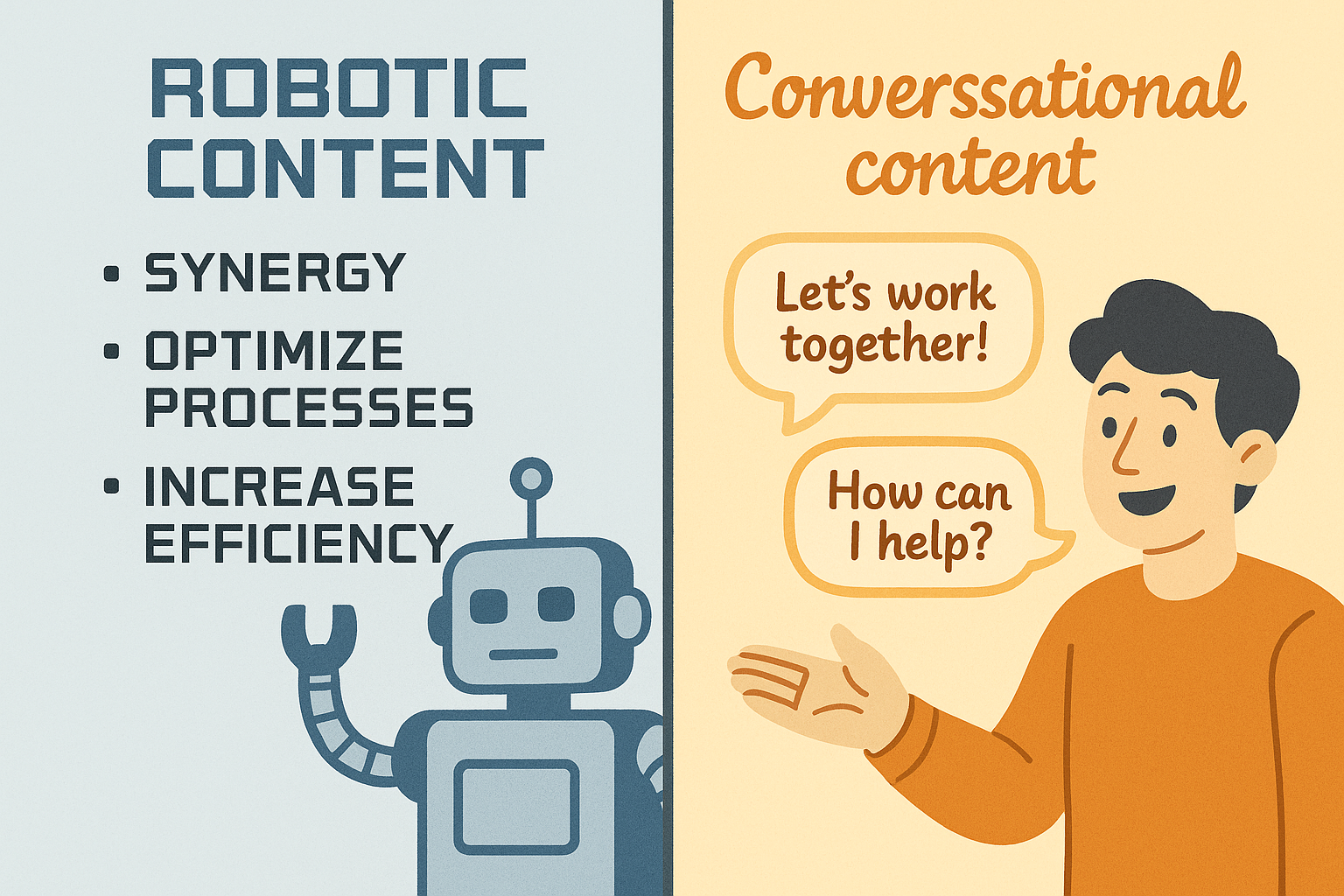
The Conversational Content Revolution
Think about how you explain your business when you meet someone at a networking event. You don’t recite your website’s “About” page verbatim or launch into a list of features and benefits. Instead, you tell a story, answer questions, and adapt your explanation based on the person’s interests and background.
This is exactly the approach that works best for AI optimization. When someone asks ChatGPT about solutions in your industry, the AI system is essentially having a conversation on behalf of that user. Content that mirrors natural conversation patterns is more likely to be selected, understood, and recommended by AI systems.
The shift toward conversational content isn’t just about tone – it’s about structure, information hierarchy, and the way you anticipate and answer questions. Instead of organizing content around keywords or product features, you organize it around the questions your customers actually ask and the problems they’re trying to solve.
Anticipating Questions Like a Mind Reader
The most successful AI-optimized content anticipates the follow-up questions that users are likely to ask. When someone inquires about project management software, they don’t just want to know what features you offer – they want to understand how those features solve their specific problems, what the learning curve looks like, and how your solution compares to alternatives they’re considering.
This question-anticipation approach requires thinking beyond your immediate product or service to understand the broader context of your customers’ decision-making process. What concerns keep them up at night? What objections do they typically raise? What additional information do they need to feel confident in their choice?
For example, instead of writing a section titled “Advanced Reporting Features,” you might write “How Can You Track Team Productivity Without Micromanaging?” This approach addresses the same functionality while framing it in terms of the actual problem your customers are trying to solve.
The beauty of this approach is that it serves both human readers and AI systems simultaneously. Humans appreciate content that directly addresses their concerns, while AI systems are trained to recognize and value content that provides comprehensive, contextual answers to user queries.
The Art of Natural Language Optimization
Traditional SEO taught us to work keywords into content in specific densities and positions. AI optimization requires a more sophisticated approach that focuses on semantic relationships and contextual relevance rather than exact keyword matches.
Instead of forcing the phrase “ChatGPT index website” into every paragraph, focus on naturally discussing the concepts, challenges, and solutions related to AI visibility. Use synonyms, related terms, and contextual phrases that demonstrate deep understanding of the topic rather than mechanical keyword insertion.
AI systems are remarkably good at understanding intent and context. They can recognize when content genuinely addresses a topic versus when it’s been artificially optimized for search engines. This means that authentic expertise and genuine helpfulness often outperform technically perfect but soulless content.
The goal is to write content that would be valuable and engaging even if search engines and AI systems didn’t exist. When you focus on creating genuinely helpful content for your target audience, AI optimization often happens naturally as a byproduct of quality and relevance.
Structuring Content for AI Comprehension
While conversational tone is important, structure still matters enormously for AI systems. The way you organize information, use headings, and create logical flow directly impacts how well AI systems can understand and utilize your content.
Use descriptive headings that clearly indicate what each section covers. Instead of clever or cryptic headings that require context to understand, opt for clear, descriptive titles that immediately communicate the value of each section. AI systems rely heavily on headings to understand content structure and identify relevant information for specific queries.
Create logical information hierarchies that build from general concepts to specific details. Start with broad context that helps AI systems understand the overall topic, then dive into specific applications, examples, and actionable advice. This structure mirrors the way AI systems process and synthesize information for user responses.
Include relevant examples, case studies, and real-world applications throughout your content. AI systems value concrete examples because they help illustrate abstract concepts and provide specific details that can be referenced in responses to user queries.
The Question-and-Answer Content Strategy
One of the most effective approaches for AI optimization is structuring content around common questions and comprehensive answers. This format aligns perfectly with how users interact with AI systems and how those systems process and present information.
Instead of traditional blog post structures, consider organizing content as a series of questions that your target audience frequently asks, followed by detailed, conversational answers. This approach makes it easy for AI systems to extract relevant information for specific user queries while providing comprehensive coverage of your topic.
For each question, provide context about why it matters, a clear answer, and practical implications or next steps. This comprehensive approach increases the likelihood that AI systems will view your content as authoritative and worth citing in responses to related queries.
The question-and-answer format also makes your content more scannable for human readers, improving user experience metrics that indirectly influence both traditional search rankings and AI visibility.
Demonstrating Expertise Without Jargon
AI systems are trained to recognize expertise and authority, but they’re also designed to value accessibility and clarity. The most effective AI-optimized content demonstrates deep knowledge while remaining understandable to non-experts.
Use specific examples, data points, and real-world applications to demonstrate expertise rather than relying on industry jargon or complex terminology. When technical terms are necessary, provide clear explanations or context that helps both AI systems and human readers understand their significance.
Share insights from your actual experience working with clients or customers. AI systems value content that provides unique perspectives and practical wisdom that can’t be found elsewhere. This experiential knowledge often becomes the differentiating factor that makes AI systems choose your content over generic alternatives.
Include relevant statistics, research findings, and industry trends that support your points. AI systems often look for factual backing when evaluating content credibility, and well-sourced information increases the likelihood of being cited in AI responses.
The Personal Touch That AI Systems Love
Here’s something that might surprise you: AI systems often prefer content with personality and individual perspective over sterile, corporate-approved messaging. This preference stems from their training on human-generated content, which naturally includes personal experiences, opinions, and unique viewpoints.
Don’t be afraid to share your perspective on industry trends, common challenges, or best practices. AI systems are trained to recognize and value authentic expertise, and personal insights often provide the unique angle that makes your content worth citing over more generic alternatives.
Use first-person language when appropriate, especially when sharing experiences or lessons learned. This personal approach helps AI systems understand that your content comes from direct experience rather than theoretical knowledge, increasing its perceived value and authority.
Include anecdotes and real-world examples from your work with clients or customers. These stories provide concrete context that AI systems can reference when explaining concepts to users, making your content more likely to be selected for relevant queries.
Optimizing for Voice and Conversational Queries
As AI systems become more sophisticated, they’re increasingly handling voice queries and conversational interactions that mirror natural speech patterns. This trend makes conversational content optimization even more important for future AI visibility.
Write content that sounds natural when read aloud. This approach ensures that your content works well for voice-based AI interactions while remaining engaging for traditional text-based consumption. Read your content out loud during the editing process to identify awkward phrasing or unnatural language patterns.
Use contractions, colloquialisms, and natural speech patterns where appropriate. While maintaining professionalism, don’t be afraid to write in a way that reflects how people actually speak about your industry or topic.
Structure sentences and paragraphs for easy comprehension and natural flow. Long, complex sentences that work fine in academic writing can be difficult for AI systems to parse and present clearly in conversational responses.
The businesses that master conversational content optimization now will have a significant advantage as AI systems continue to evolve toward more natural, human-like interactions. You’re not just optimizing for current AI capabilities – you’re preparing for the future of human-AI communication.
Give AI the Context It Craves
While ChatGPT doesn’t directly read schema markup the way traditional search engines do, structured data plays a crucial behind-the-scenes role in your AI visibility strategy. Since ChatGPT relies heavily on search engine indexes (particularly Bing’s), and those search engines use schema markup to better understand and rank content, your structured data indirectly influences how AI systems perceive and present your business.
Think of schema markup as providing subtitles for a foreign film. Without it, AI systems can still understand your content, but they might miss important nuances about what type of business you are, what services you offer, or why you’re particularly qualified to help with specific problems. With proper schema markup, you’re giving AI systems the context they need to confidently recommend you to users.
Understanding Schema’s Role in AI Visibility
Schema markup creates a structured data layer that helps search engines understand the relationships between different pieces of information on your website. When Bing indexes your content with proper schema markup, it creates richer, more contextual data that ChatGPT can draw from when formulating responses.
For example, if you’re a local restaurant, schema markup can help search engines understand your cuisine type, price range, location, hours of operation, and customer ratings. When someone asks ChatGPT for restaurant recommendations in your area, this structured information makes it more likely that you’ll be mentioned with accurate, compelling details.
The indirect nature of schema’s impact on AI visibility means that many businesses overlook this optimization opportunity. While they’re focused on content creation and keyword optimization, they’re missing the structured data foundation that could significantly improve how AI systems understand and present their business.
Essential Schema Types for AI Optimization
Not all schema markup is equally important for AI visibility. Focus on the schema types that provide the most valuable context for how AI systems might recommend your business to users.
Organization Schema is fundamental for any business seeking AI visibility. This markup helps AI systems understand basic information about your company, including your name, location, contact information, and areas of expertise. It’s the foundation that other schema types build upon.
Article Schema is crucial for content-based businesses and thought leadership strategies. This markup helps AI systems understand the authorship, publication date, and topic focus of your content, making it more likely to be cited for relevant queries.
FAQ Schema is particularly valuable because it aligns perfectly with how users interact with AI systems. When your FAQ content is properly marked up, AI systems can easily extract specific questions and answers to include in their responses.
Service Schema helps AI systems understand what you offer and who you serve. This markup is especially important for service-based businesses that want to be recommended for specific types of problems or customer needs.
Review Schema provides social proof that AI systems can reference when recommending your business. Positive reviews marked up with proper schema can be mentioned in AI responses, adding credibility to recommendations.
Implementing Schema with Rank Math
If you’re using Rank Math, implementing schema markup becomes significantly easier than manual coding approaches. The plugin automatically generates appropriate schema markup based on your content type and provides user-friendly interfaces for adding specific details.
For blog posts and articles, Rank Math automatically creates Article schema that includes authorship information, publication dates, and content categorization. This automation ensures that your content is properly structured for both search engines and AI systems without requiring technical expertise.
The plugin also provides specific schema options for different business types, allowing you to add detailed information about your services, location, contact information, and other relevant details. This comprehensive approach ensures that AI systems have access to all the context they need to accurately represent your business.
Optimizing Schema for AI Understanding
While implementing basic schema markup is important, optimizing it specifically for AI comprehension requires a more strategic approach. Focus on providing comprehensive, accurate information that helps AI systems understand not just what you do, but why you’re uniquely qualified to do it.
Use descriptive language in your schema markup rather than generic terms. Instead of simply marking up your business as “consulting,” specify “digital marketing consulting for small businesses” or “sustainability consulting for manufacturing companies.” This specificity helps AI systems make more accurate recommendations.
Include relevant keywords and phrases in your schema descriptions, but prioritize clarity and accuracy over keyword density. AI systems are sophisticated enough to understand context and relationships, so focus on providing genuinely helpful information rather than trying to game the system.
Keep your schema markup updated as your business evolves. Outdated or inaccurate structured data can confuse AI systems and lead to incorrect recommendations or missed opportunities.
Local Business Schema for Geographic Relevance
If you serve customers in specific geographic areas, local business schema becomes crucial for AI visibility. This markup helps AI systems understand your service area, location, and local relevance when users ask for geographically specific recommendations.
Include comprehensive location information, including your full address, phone number, and service areas. This information helps AI systems determine when to recommend your business for location-based queries.
Add operating hours, especially if they vary by day or season. AI systems often consider availability when making recommendations, and accurate hours information can influence whether you’re suggested for time-sensitive queries.
Include local landmarks, neighborhood names, or geographic features that help establish your local relevance. This contextual information can improve your chances of being recommended for queries that include local references or geographic qualifiers.
Measuring Schema Impact on AI Visibility
Unlike traditional SEO metrics, measuring the impact of schema markup on AI visibility requires indirect assessment methods. You won’t see immediate changes in Google Analytics, but you can monitor several indicators that suggest improved AI understanding of your business.
Test how your business appears in ChatGPT responses for relevant queries. Look for improvements in accuracy, completeness, and context when AI systems describe your services or recommend your business. These qualitative improvements often indicate that your schema markup is providing valuable context.
Monitor your search engine performance for rich snippets and enhanced search results. While this doesn’t directly measure AI visibility, it indicates that search engines are successfully parsing your schema markup, which improves the quality of data available to AI systems.
Track referral traffic patterns and user behavior metrics. Users who discover your business through AI recommendations often exhibit different browsing patterns than traditional search traffic, potentially spending more time on specific pages or showing higher engagement with particular content types.
Advanced Schema Strategies for Competitive Advantage
As more businesses implement basic schema markup, advanced strategies become important for maintaining competitive advantage in AI visibility. Consider implementing less common schema types that provide unique context about your business or industry expertise.
Course Schema can be valuable for businesses that offer training, education, or skill development services. This markup helps AI systems understand your educational offerings and recommend you for learning-related queries.
Event Schema is useful for businesses that host workshops, webinars, or industry events. This markup can help AI systems recommend your events when users ask about learning opportunities or industry gatherings.
Product Schema with detailed specifications and reviews can significantly improve e-commerce AI visibility. Comprehensive product markup helps AI systems make specific product recommendations based on user needs and preferences.
Recipe Schema isn’t just for food blogs – it can be adapted for any step-by-step process or methodology. This creative application can help AI systems recommend your business for process-related queries in your industry.
The Future of Schema and AI Integration
As AI systems become more sophisticated, their ability to understand and utilize structured data will continue to evolve. Businesses that invest in comprehensive schema markup now are building the foundation for future AI visibility advantages.
The trend toward more conversational and context-aware AI interactions makes structured data increasingly valuable. Schema markup provides the contextual framework that allows AI systems to make nuanced, accurate recommendations rather than generic suggestions.
Consider schema markup as an investment in long-term AI visibility rather than a quick fix for immediate results. The businesses that will dominate AI search in the coming years are those that provide AI systems with the richest, most accurate context about their expertise, services, and value propositions.
How to Know If You’re Winning the AI Game
Measuring your success in ChatGPT optimization requires a different approach than traditional SEO metrics. You can’t simply check your rankings in Google Search Console or track keyword positions. Instead, you need to monitor how AI systems perceive, understand, and recommend your business – which requires both quantitative tracking and qualitative assessment.
The first time I saw my client’s business mentioned in a ChatGPT response, I did a little victory dance in my office. It wasn’t just that they were mentioned – it was how they were described. ChatGPT didn’t just list their company name; it provided context about their expertise, explained why they were particularly well-suited for the user’s specific needs, and even mentioned their unique approach to solving common industry problems. That’s when I knew we had successfully optimized for AI visibility.
Direct AI Testing: Your Primary Success Metric
The most reliable way to measure your ChatGPT visibility is through direct testing. Regularly ask ChatGPT questions that your potential customers might ask, and monitor whether your business appears in the responses. This hands-on approach provides immediate feedback about your AI optimization efforts.
Create a list of 10-15 queries that represent different ways customers might discover your business. Include broad industry questions (“What’s the best way to…”), specific problem-solving queries (“How can I fix…”), and recommendation requests (“What companies provide…”). Test these queries monthly and document the results.
Pay attention not just to whether you’re mentioned, but how you’re described. Are the details accurate? Does ChatGPT understand your unique value proposition? Is the context appropriate for the query? These qualitative factors often matter more than simple mention frequency.
Keep detailed records of your testing results, including screenshots and notes about the context of each mention. This documentation helps you identify patterns, track improvements over time, and understand which optimization strategies are most effective for your specific business.
Analytics Patterns That Indicate AI Traffic
While ChatGPT doesn’t always provide direct links to websites, users often visit sites after receiving AI recommendations. This behavior creates distinctive traffic patterns that you can identify in your analytics data.
Look for increases in direct traffic that can’t be attributed to other marketing activities. Users who discover your business through AI recommendations often type your URL directly into their browser or search for your business name specifically.
Monitor referral traffic from unusual sources or platforms that might indicate AI-driven discovery. While ChatGPT itself won’t show up as a referral source, users might visit your site after copying links from AI conversations or searching for your business after an AI recommendation.
Pay attention to changes in user behavior metrics. Visitors who discover your business through AI recommendations often exhibit different browsing patterns – they might spend more time on specific pages, have lower bounce rates, or show higher engagement with particular types of content.
Track increases in branded search queries. When AI systems recommend your business, users often follow up by searching for your company name or specific services, creating measurable increases in branded search volume.
Social Listening for AI Mentions
AI conversations are increasingly happening in public forums, social media platforms, and professional networks. Monitoring these channels can provide valuable insights into how your business is being discussed in AI-powered contexts.
Set up Google Alerts for your business name combined with terms like “ChatGPT,” “AI recommendation,” or “artificial intelligence.” This monitoring can help you identify when people are sharing AI-generated recommendations that include your business.
Monitor social media platforms for screenshots or discussions of AI conversations that mention your business. Users often share interesting or helpful AI responses, providing visibility into how your business is being presented in AI contexts.
Join industry forums and professional groups where people might share AI-generated advice or recommendations. These communities often provide early indicators of how AI systems are perceiving and recommending businesses in your industry.
Competitive Analysis in the AI Landscape
Understanding how your competitors appear in AI responses provides valuable context for your own optimization efforts. Regular competitive analysis helps you identify opportunities and benchmark your progress against industry standards.
Test the same queries you use for your own business, but focus on how competitors are mentioned. Are they appearing more frequently? Are their descriptions more detailed or compelling? This analysis helps you identify areas where your optimization strategy might need adjustment.
Look for patterns in how AI systems describe different businesses in your industry. Do certain types of descriptions or value propositions seem to resonate better with AI systems? This insight can inform your content strategy and messaging optimization.
Monitor whether new competitors are gaining AI visibility while established players remain invisible. This intelligence can help you identify emerging threats and opportunities in your market.
Long-Term Tracking and Trend Analysis
AI optimization is a long-term strategy that requires patience and consistent monitoring. Establish baseline measurements and track changes over time to understand the impact of your optimization efforts.
Create monthly reports that document your AI visibility across different query types and contexts. Include both quantitative data (frequency of mentions, traffic patterns) and qualitative observations (accuracy of descriptions, context appropriateness).
Track correlations between your optimization activities and changes in AI visibility. Did implementing LLMS.txt lead to more accurate descriptions? Did improving your Bing rankings increase mention frequency? These correlations help you understand which strategies are most effective.
Monitor industry trends and changes in AI behavior that might affect your visibility strategy. As AI systems evolve and new platforms emerge, your measurement and optimization approaches may need to adapt accordingly.
The AI Revolution Isn’t Coming – It’s Here. Make Sure You’re Part of It.
We’re living through one of the most significant shifts in how people discover and evaluate businesses since the advent of the internet itself. While everyone was busy optimizing for Google’s algorithm updates and chasing the latest SEO trends, artificial intelligence quietly revolutionized the entire landscape of information discovery.
The businesses that recognize this shift and adapt quickly will gain an enormous competitive advantage. Those that continue to rely solely on traditional SEO strategies will find themselves increasingly invisible to a growing segment of potential customers who prefer conversational AI over traditional search engines.
Sarah’s bakery story from our introduction has a happy ending. After implementing the strategies we’ve discussed – optimizing her robots.txt file, setting up Bing Webmaster Tools, creating an LLMS.txt file, and transforming her content to be more conversational – she started appearing in ChatGPT responses within six weeks. More importantly, the AI descriptions of her bakery were accurate, compelling, and often included specific details about her signature sourdough and locally-sourced ingredients.
The customers who discovered her through AI recommendations became some of her most loyal patrons. They arrived already convinced of her expertise and quality, having received detailed explanations of what made her bakery special. Her revenue not only recovered but exceeded previous levels, and she gained a sustainable competitive advantage over competitors who remained invisible to AI search.
Your Action Plan for AI Dominance
The strategies we’ve covered aren’t theoretical concepts for future implementation – they’re practical steps you can take today to start building your AI visibility. The businesses that act now, while their competitors are still figuring out what ChatGPT means for their industry, will establish advantages that compound over time.
Start with the technical foundations: ensure your robots.txt file allows OpenAI crawlers, set up Bing Webmaster Tools, and implement LLMS.txt through Rank Math. These steps can be completed in a single afternoon and provide the infrastructure for everything else you’ll build.
Transform your content strategy to focus on conversational, question-answering formats that mirror how people interact with AI systems. This isn’t about rewriting everything overnight – it’s about gradually shifting your approach to create content that serves both human readers and AI systems effectively.
Implement comprehensive schema markup that provides AI systems with the context they need to understand and recommend your business accurately. This structured data foundation will become increasingly important as AI systems become more sophisticated in their understanding and utilization of web content.
The Compound Effect of Early Adoption
The businesses that will dominate their industries in the AI era are those that understand the compound effect of early optimization. Every month you delay implementation is a month your competitors could be building AI visibility while you remain invisible.
AI optimization isn’t just about appearing in ChatGPT responses – it’s about positioning your business for success in an increasingly AI-driven world. As artificial intelligence becomes more integrated into customer research, decision-making, and purchasing processes, the businesses with strong AI visibility will have sustainable competitive advantages.
The strategies we’ve discussed will continue to evolve as AI systems become more sophisticated, but the fundamental principles remain constant: provide clear, valuable, contextual information that helps AI systems understand why your business deserves to be recommended to users.
The Future Belongs to AI-Optimized Businesses
We’re still in the early stages of the AI revolution, but the trajectory is clear. Artificial intelligence will play an increasingly important role in how people discover, evaluate, and choose businesses. The companies that recognize this trend and optimize accordingly will thrive, while those that ignore it will struggle to remain relevant.
The choice is yours: you can wait and see how AI search develops, hoping that your current optimization strategies will be sufficient, or you can take action now to ensure your business is visible and compelling in AI-powered conversations.
The businesses that choose to act now, while AI optimization is still a competitive advantage rather than a basic requirement, will establish market positions that become increasingly difficult for competitors to challenge. They’ll be the companies that AI systems confidently recommend, the businesses that appear in AI conversations with compelling descriptions and clear value propositions.
Don’t let your business become invisible in the AI era. The tools, strategies, and opportunities are available right now. The only question is whether you’ll use them before your competitors do.
The AI revolution isn’t coming – it’s here. Make sure you’re part of it.
Ready to dominate AI search for your business? Start implementing these strategies today and position yourself for success in the AI-driven future of customer discovery.