This Call Forwarding Secret Is Transforming How Professionals Work

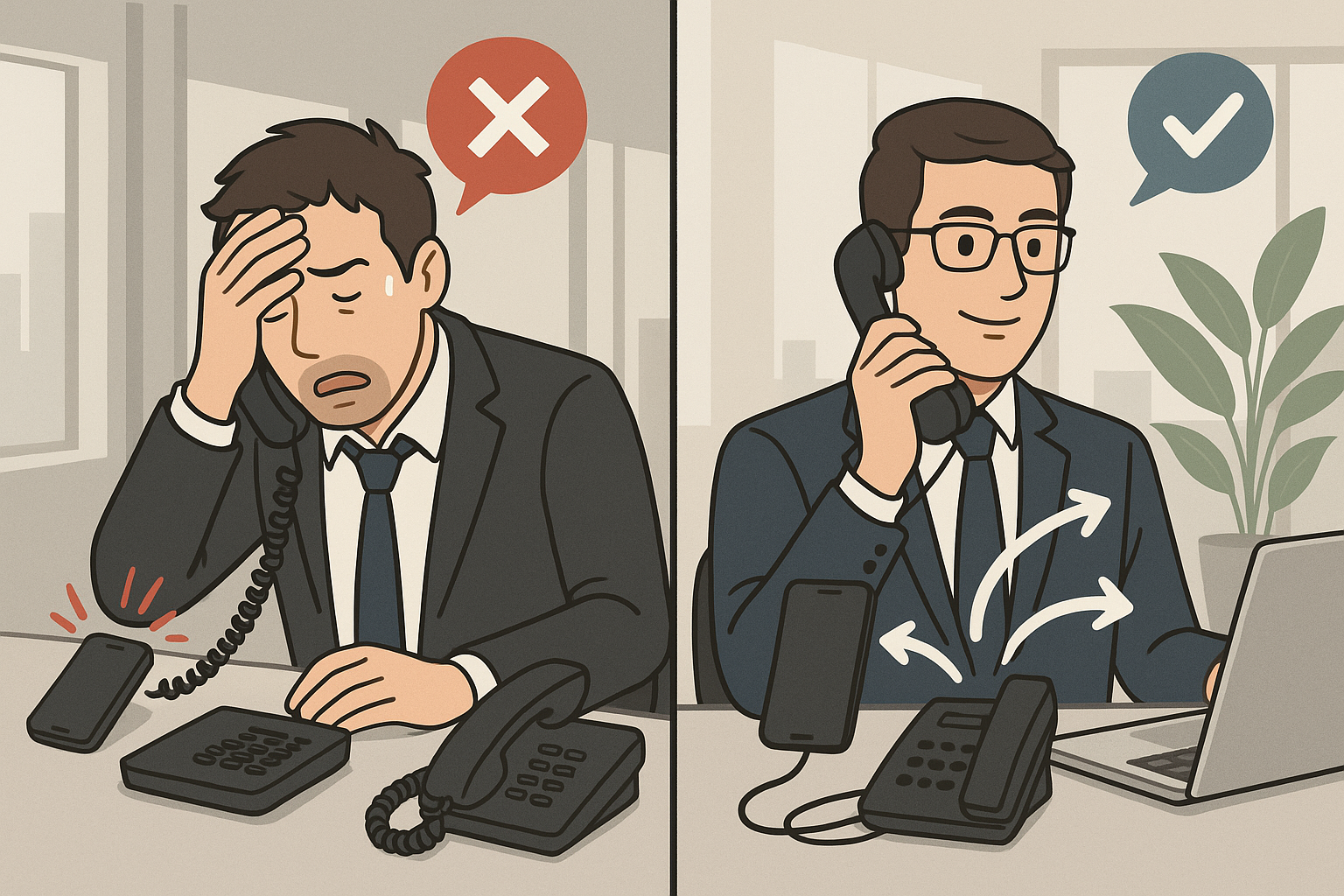
Picture this: You’re in the middle of the most important client presentation of your career when your phone starts buzzing incessantly. Your daughter’s school is calling about an emergency, but you can’t answer without appearing unprofessional. Meanwhile, three potential clients are trying to reach your office line, but you’re not there to take their calls. By the time you check your messages hours later, two of those prospects have already moved on to your competitors.
This nightmare scenario plays out thousands of times every day for busy professionals across Montreal and beyond. In fact, studies show that businesses lose an average of $62,000 annually due to missed calls [1]. But here’s the thing that successful professionals know and struggling ones don’t: there’s a simple solution that can eliminate this problem entirely.
Call forwarding for professionals isn’t just about redirecting phone calls—it’s about creating a seamless communication ecosystem that ensures you never miss another opportunity, emergency, or important conversation again. The professionals who master this technology don’t just stay connected; they gain a competitive advantage that transforms their entire approach to business communication.
In this comprehensive guide, we’ll reveal the exact call forwarding strategies that Montreal’s most successful professionals use to stay ahead of the competition. You’ll discover real-world case studies, step-by-step tutorials, and insider secrets that most people never learn. By the end of this article, you’ll have everything you need to implement a professional phone management system that works around the clock, even when you don’t.
Understanding Call Forwarding for Professionals: More Than Just Redirecting Calls
Call forwarding for professionals represents a fundamental shift in how modern businesses handle communication. Unlike basic call redirection, professional call forwarding involves sophisticated routing systems that can intelligently direct calls based on time, caller identity, availability status, and business priorities.
At its core, business call forwarding is a telecommunications feature that automatically redirects incoming calls from your primary business number to another designated phone number. This could be your mobile device, home office line, virtual assistant, or even a sophisticated call center system. However, the real power lies in the advanced features that separate amateur setups from professional-grade systems.
Modern call forwarding for professionals includes conditional forwarding, which activates only under specific circumstances such as when your line is busy, when you don’t answer within a certain number of rings, or during predetermined time periods. There’s also unconditional forwarding, which redirects all calls immediately without ringing your primary line first. The choice between these options depends on your specific business needs and communication strategy.
Professional phone management systems also incorporate features like simultaneous ringing, where multiple devices ring at once, and sequential forwarding, where calls are routed through a predetermined hierarchy of numbers until someone answers. These advanced capabilities ensure that important calls never fall through the cracks, regardless of where you are or what you’re doing.
The technology behind call forwarding has evolved significantly with the rise of Voice over Internet Protocol (VoIP) systems and cloud-based communication platforms. These modern solutions offer unprecedented flexibility and control, allowing professionals to manage their call forwarding rules through intuitive web interfaces and mobile applications. This means you can adjust your call forwarding settings in real-time, responding to changing business needs and personal schedules with just a few taps on your smartphone.
The Hidden Costs of Poor Professional Phone Management
Before diving into the solutions, it’s crucial to understand exactly what’s at stake when professionals fail to implement proper call forwarding systems. The costs extend far beyond missed revenue opportunities, affecting reputation, client relationships, and long-term business growth.
Research conducted by the Harvard Business Review found that 67% of potential customers will hang up if they can’t reach a live person within the first three rings [2]. For service-based professionals like lawyers, consultants, and healthcare providers, this statistic represents a staggering loss of potential business. Consider that the average professional services client has a lifetime value of 15,000to15,000 to 15,000to50,000, and suddenly those missed calls become extremely expensive mistakes.
The reputation damage can be even more costly than immediate lost revenue. In today’s hyperconnected world, clients expect instant accessibility. When professionals are unreachable during business hours, it sends a message about priorities and professionalism that can take months or years to overcome. Social media and online review platforms amplify these negative experiences, turning a single missed call into a public relations challenge.
Montreal-based attorney Marie Dubois learned this lesson the hard way. “I lost a major corporate client because I missed their urgent call during a court appearance,” she recalls. “They needed immediate legal advice for a time-sensitive merger, and when they couldn’t reach me, they called my competitor instead. That single missed call cost me over $200,000 in potential fees over the following year.”
The psychological toll on professionals is another hidden cost that’s rarely discussed. The constant anxiety about missing important calls creates a state of perpetual stress that affects decision-making, creativity, and overall job satisfaction. Many professionals report checking their phones obsessively, even during family time and vacations, because they fear missing something critical.
Emergency situations present perhaps the most serious consequences of inadequate call forwarding for professionals. Healthcare providers who can’t be reached during medical emergencies, lawyers who miss urgent legal deadlines, and consultants who fail to respond to crisis situations face not only financial losses but potential legal liability and professional sanctions.
Real-World Success Stories: How Montreal Professionals Transformed Their Practices

The difference between struggling and thriving professionals often comes down to how effectively they manage their communication systems. Let’s examine three detailed case studies of Montreal professionals who revolutionized their practices through strategic call forwarding implementation.
Sarah’s Transformation: From Overwhelmed Marketing Manager to Communication Master
Sarah Leblanc, a marketing manager at a growing Montreal tech startup, found herself drowning in communication chaos. As the company’s primary client contact, she was receiving over 50 calls per day while simultaneously managing internal meetings, strategy sessions, and her daughter’s school schedule. The breaking point came when she missed a call from their largest client during her daughter’s parent-teacher conference, nearly losing a $500,000 contract renewal.
“I was constantly torn between being a good mother and a dedicated professional,” Sarah explains. “Every time my phone rang, I felt this surge of anxiety because I never knew if it was an emergency at school or a critical business call. I was failing at both roles because I couldn’t give either my full attention.”
Sarah’s solution involved implementing a sophisticated call forwarding for professionals system that used caller identification and time-based routing. During school hours, calls from her daughter’s school were immediately forwarded to her mobile phone, while business calls went to her office line. After 5 PM and on weekends, all business calls were forwarded to a professional answering service that could handle routine inquiries and escalate emergencies to her mobile phone.
The results were transformative. Within three months, Sarah’s client satisfaction scores increased by 40%, and she reported significantly reduced stress levels. “Now I can be fully present in meetings because I know that if there’s a real emergency with my daughter, the call will reach me immediately,” she says. “And my clients appreciate that they can always reach someone knowledgeable about their accounts, even when I’m not available.”
The technical implementation involved setting up conditional call forwarding rules through her company’s VoIP system. Sarah worked with Mainstream Digicom to configure multiple forwarding scenarios: immediate forwarding for priority contacts, delayed forwarding for general business calls, and voicemail routing for non-urgent matters. The system also included SMS notifications for missed calls, ensuring she could follow up quickly when appropriate.
Mark’s International Success: Seamless Communication Across Time Zones
Mark Chen, founder of a Montreal-based software consulting firm, faced a different challenge. His business had grown to serve clients across North America and Europe, meaning important calls could come in at any hour. Traditional business hours were meaningless when dealing with clients in London, Tokyo, and San Francisco simultaneously.
“I was essentially on call 24/7, which was unsustainable,” Mark recalls. “I was taking client calls at 2 AM and during family dinners. My wife threatened to hide my phone if I didn’t find a better solution. But I also couldn’t afford to miss opportunities in different time zones.”
Mark’s call forwarding for professionals strategy involved creating a sophisticated routing system that considered both time zones and call priority. High-priority clients were given direct access to his mobile phone during extended business hours, while general inquiries were routed to different team members based on their expertise and availability. International calls were handled through a virtual assistant service during off-hours, with emergency escalation protocols for truly urgent matters.
The system included geographic routing, where calls from European clients were automatically forwarded to his early-morning mobile hours (5 AM to 8 AM Montreal time), while West Coast calls were handled during extended evening hours (7 PM to 10 PM). This allowed Mark to maintain work-life balance while ensuring clients felt valued and supported regardless of their location.
“The game-changer was realizing that not every call needed my personal attention immediately,” Mark explains. “By categorizing calls and creating smart routing rules, I could be available for the conversations that truly required my expertise while delegating or scheduling others appropriately.”
The technical setup involved integrating his business phone system with customer relationship management (CRM) software, allowing the system to recognize caller information and route accordingly. Mark also implemented call recording and transcription services, enabling him to review important conversations that occurred during off-hours and respond appropriately the next business day.
Lisa’s Legal Practice: Building Trust Through Accessibility
Lisa Rodriguez, a Montreal immigration lawyer, discovered that her clients’ needs didn’t conform to traditional business hours. Immigration emergencies, deportation notices, and urgent document requirements could arise at any time, and her clients—many of whom were already stressed and vulnerable—needed to know they could reach their legal counsel when crises occurred.
“Immigration law isn’t a 9-to-5 business,” Lisa explains. “When someone receives a deportation notice or faces an emergency at the border, they need immediate legal guidance. My clients were calling at all hours, and I realized that accessibility was not just a convenience—it was a fundamental part of providing ethical legal representation.”
Lisa’s approach to call forwarding for professionals focused on creating multiple tiers of accessibility. True emergencies were routed directly to her mobile phone 24/7, while general questions were directed to a legal assistant during business hours and to a specialized legal answering service after hours. The key was training her support team to recognize genuine emergencies and escalate appropriately.
The system included a callback guarantee: all calls received responses within two hours during business days and within four hours on weekends and holidays. This commitment to responsiveness became a cornerstone of her practice’s reputation and a significant competitive advantage in Montreal’s crowded legal market.
“My clients know they can reach me when they truly need me, but they also respect that I have boundaries,” Lisa says. “The system allows me to be incredibly responsive without being constantly interrupted by non-urgent matters. It’s actually made me a better lawyer because I can focus deeply on complex cases while still being available for emergencies.”
The technical implementation involved creating detailed call scripts for her answering service, training staff to recognize legal emergencies, and establishing secure communication protocols for sensitive information. Lisa also implemented a client portal where routine questions could be submitted and tracked, reducing the overall volume of phone calls while improving service quality.
Advanced Call Forwarding Strategies for Different Professional Sectors
Different professional sectors require tailored approaches to call forwarding for professionals. What works for a healthcare provider may not be appropriate for a financial advisor, and real estate agents have different needs than management consultants. Understanding these sector-specific requirements is crucial for implementing an effective professional phone management system.
Healthcare Professionals: Life-and-Death Communication
Healthcare providers face unique challenges in call forwarding implementation due to patient privacy regulations, emergency protocols, and the critical nature of medical communications. HIPAA compliance requirements mean that not all forwarding solutions are appropriate for medical practices, and the potential for life-threatening emergencies requires sophisticated escalation procedures.
Dr. Jennifer Walsh, a Montreal cardiologist, implemented a multi-tiered call forwarding system that distinguishes between routine appointment scheduling, urgent medical questions, and true emergencies. “In cardiology, the difference between a routine follow-up call and a cardiac emergency can be a matter of life and death,” she explains. “Our call forwarding system needs to recognize these distinctions and respond appropriately.”
Her system routes routine calls to administrative staff during business hours and to a medical answering service after hours. Calls from hospital emergency departments and established patients with specific emergency codes are forwarded directly to her mobile phone. The system also includes automatic documentation features that create records of all forwarded calls for compliance purposes.
The technical implementation required HIPAA-compliant forwarding services and encrypted communication channels. Dr. Walsh worked with specialized medical communication providers to ensure that patient information remained secure throughout the forwarding process. The system also includes automatic callback features for missed emergency calls and integration with hospital paging systems.
Legal Professionals: Confidentiality and Urgency
Legal professionals must balance client accessibility with confidentiality requirements and court schedules. Attorney-client privilege extends to phone communications, making secure call forwarding essential. Additionally, legal emergencies often occur outside business hours, requiring sophisticated after-hours protocols.
Montreal criminal defense attorney Robert Tremblay developed a call forwarding for professionals system that recognizes different types of legal emergencies. “When someone is arrested, they need immediate legal representation,” he explains. “But I also have clients calling about contract questions that can wait until morning. The system needs to distinguish between these scenarios.”
His implementation includes secure forwarding to a legal assistant for routine matters, direct forwarding to his mobile phone for current clients facing emergencies, and a specialized legal answering service for new client inquiries. The system also integrates with court scheduling software to automatically adjust forwarding rules based on his courtroom appearances.
Security features include end-to-end encryption for all forwarded calls and automatic deletion of call recordings after specified periods. The system also provides detailed logs for billing purposes and professional responsibility compliance.
Real Estate Professionals: Timing Is Everything
Real estate professionals operate in a market where timing can make or break deals. A delayed response to a buyer’s inquiry or a missed call from a seller can result in lost commissions worth thousands of dollars. However, real estate agents also need personal time and often work irregular schedules that don’t align with traditional business hours.
Montreal real estate agent Sophie Martin created a call forwarding system that adapts to market conditions and personal schedules. “In real estate, you’re always on call, but you also need to maintain some work-life balance,” she says. “The key is creating a system that ensures urgent calls reach you immediately while filtering out non-urgent matters.”
Her system uses caller identification to prioritize calls from active clients, other real estate agents, and mortgage brokers. During property showings, calls are automatically forwarded to voicemail with immediate text message notifications. After hours, the system routes calls through a real estate answering service that can schedule appointments and provide basic property information.
The technical setup includes integration with multiple listing services (MLS) and customer relationship management (CRM) systems. This allows the forwarding system to recognize callers and provide context-appropriate responses. The system also includes location-based forwarding that adjusts based on Sophie’s current location and schedule.
Management Consultants: Global Accessibility
Management consultants often work with clients across multiple time zones and industries, requiring flexible call forwarding solutions that can adapt to changing project requirements and travel schedules. The challenge is maintaining professional accessibility while managing diverse client needs and expectations.
Montreal-based consultant David Kim developed a call forwarding for professionals system that creates virtual presence across multiple time zones. “My clients are in Toronto, New York, London, and Singapore,” he explains. “I need to be accessible during their business hours while still maintaining some semblance of personal time.”
His system includes time-zone-aware forwarding that routes calls to different numbers based on the caller’s location and the time of day. During travel, the system automatically adjusts to his current time zone and location. Emergency escalation procedures ensure that truly urgent matters reach him regardless of time or location.
The implementation includes integration with project management software and client communication platforms. This allows the system to provide context about ongoing projects and route calls to appropriate team members when David is unavailable. The system also includes automatic scheduling features that can book follow-up calls and meetings based on availability across multiple time zones.
Technical Deep Dive: VoIP vs. Traditional Call Forwarding Systems
Understanding the technical differences between various call forwarding technologies is crucial for professionals who want to implement the most effective solution for their specific needs. The choice between traditional landline forwarding, VoIP-based systems, and cloud-based solutions can significantly impact functionality, cost, and reliability.
Traditional landline call forwarding operates through the Public Switched Telephone Network (PSTN) using simple redirect commands. When you activate call forwarding on a traditional phone line, the telephone company’s switching equipment automatically routes incoming calls to your designated number. This system is reliable and works during power outages, but it offers limited flexibility and advanced features.
The primary advantage of traditional call forwarding is its simplicity and reliability. The system doesn’t depend on internet connectivity or complex software, making it ideal for professionals who prioritize reliability over advanced features. However, traditional systems typically offer only basic forwarding options: forward all calls, forward when busy, forward when no answer, and forward when unreachable.
VoIP-based call forwarding for professionals operates through internet protocols, offering significantly more flexibility and advanced features. VoIP systems can implement complex routing rules, integrate with business software, and provide detailed call analytics. The technology allows for features like simultaneous ringing, time-based routing, and caller identification-based forwarding that are impossible with traditional systems.
Modern VoIP systems also offer superior cost-effectiveness, especially for businesses that handle high call volumes or international communications. The ability to route calls through internet connections rather than traditional phone networks can result in significant cost savings, particularly for professionals who frequently communicate with clients in different countries.
Cloud-based call forwarding represents the most advanced option, combining the flexibility of VoIP with the scalability and reliability of cloud computing. These systems can automatically adjust to changing business needs, integrate with multiple communication channels (voice, text, email, chat), and provide artificial intelligence-powered features like automatic call transcription and sentiment analysis.
The technical implementation of cloud-based systems typically involves configuring forwarding rules through web-based interfaces or mobile applications. Professionals can adjust their settings in real-time, create complex conditional forwarding scenarios, and monitor call patterns through detailed analytics dashboards.
Security considerations vary significantly between these technologies. Traditional landline systems offer inherent security through the closed nature of the PSTN, but they lack encryption for forwarded calls. VoIP systems can implement end-to-end encryption but require proper configuration to ensure security. Cloud-based systems typically offer the most robust security features, including automatic encryption, secure authentication, and compliance with industry standards like HIPAA and SOX.
Reliability also differs between technologies. Traditional systems are generally most reliable during emergencies and power outages, as they don’t depend on internet connectivity or complex software. VoIP systems require stable internet connections but often include redundancy features and automatic failover to backup systems. Cloud-based solutions typically offer the highest reliability through distributed infrastructure and automatic backup systems.
Setting Up Professional Call Forwarding: Step-by-Step Implementation Guide
Implementing an effective call forwarding for professionals system requires careful planning, proper technical configuration, and ongoing optimization. This comprehensive guide will walk you through each step of the process, from initial assessment to advanced optimization techniques.
Phase 1: Assessment and Planning
The first step in implementing professional phone management is conducting a thorough assessment of your current communication needs and patterns. This involves analyzing your call volume, identifying peak calling times, categorizing call types, and understanding your availability patterns and constraints.
Begin by tracking your incoming calls for at least two weeks, noting the time, caller type, urgency level, and how each call was handled. This data will reveal patterns that inform your forwarding strategy. For example, you might discover that 60% of your calls come from existing clients, 25% are new inquiries, and 15% are vendor or administrative calls, each requiring different handling approaches.
Next, identify your availability patterns and constraints. Consider your regular schedule, travel requirements, family commitments, and professional obligations. Be honest about when you can and cannot take calls, as this information is crucial for creating realistic forwarding rules that you’ll actually follow.
Define your call priorities by categorizing contacts into different urgency levels. Emergency contacts (family, key clients, critical vendors) should have direct access to your mobile phone. Important contacts (active clients, referral sources, key partners) might warrant immediate forwarding during business hours but voicemail after hours. General contacts (new inquiries, routine vendors, administrative calls) can typically be handled through assistants or answering services.
Consider your technical requirements and constraints. Evaluate your current phone system, internet connectivity, mobile device capabilities, and budget for new technology. This assessment will help determine whether you need a simple forwarding solution or a more sophisticated system with advanced features.
Phase 2: Technology Selection and Setup
Based on your assessment, select the appropriate technology platform for your call forwarding for professionals system. For most modern professionals, a VoIP or cloud-based solution offers the best combination of features, flexibility, and cost-effectiveness.
If you choose a VoIP solution, begin by selecting a provider that offers the features you need at a price point that fits your budget. Popular options include RingCentral, Vonage Business, and 8×8, each offering different feature sets and pricing structures. Consider factors like call quality, reliability, customer support, and integration capabilities when making your selection.
For cloud-based solutions, evaluate providers like Grasshopper, Phone.com, or Nextiva that specialize in professional communication services. These platforms typically offer more advanced features like intelligent call routing, CRM integration, and detailed analytics, but may come at a higher cost.
Once you’ve selected a provider, begin the technical setup process. This typically involves porting your existing business number to the new system, configuring your forwarding rules, and testing the system thoroughly before going live. Most providers offer migration assistance and technical support during this process.
Configure your basic forwarding rules starting with simple scenarios and gradually adding complexity. Begin with time-based forwarding (business hours vs. after hours) and caller identification-based routing (known contacts vs. unknown numbers). Test each configuration thoroughly to ensure calls are routed correctly and that call quality meets your standards.
Set up your mobile device and any other endpoints that will receive forwarded calls. Install necessary applications, configure notification settings, and test call quality on each device. Ensure that you can easily identify forwarded calls and access relevant caller information when answering.
Phase 3: Advanced Configuration and Optimization
After your basic system is operational, implement advanced features that can significantly improve your professional phone management effectiveness. These might include simultaneous ringing, sequential forwarding, voicemail-to-email transcription, and integration with business software.
Simultaneous ringing allows multiple devices to ring at once, increasing the likelihood that you’ll answer important calls. Configure this feature for high-priority contacts during business hours, but be mindful of the potential for disruption if too many devices are ringing simultaneously.
Sequential forwarding routes calls through a predetermined hierarchy of numbers, trying each one until someone answers. This is particularly useful for professionals who work with assistants or team members who can handle certain types of calls. Configure the sequence based on availability and expertise, ensuring that the most appropriate person handles each call type.
Implement intelligent voicemail features like automatic transcription and email delivery. These features allow you to quickly review missed calls and determine which ones require immediate attention. Many systems also offer voicemail-to-text services that can help you understand the content of messages without listening to audio files.
Integrate your call forwarding system with other business tools like customer relationship management (CRM) software, calendar applications, and project management platforms. These integrations can provide valuable context about callers and help you manage follow-up activities more effectively.
Set up detailed call analytics and reporting features to monitor system performance and identify optimization opportunities. Track metrics like call volume, response times, missed call rates, and caller satisfaction to continuously improve your system’s effectiveness.
Troubleshooting Common Call Forwarding Issues
Even the most well-designed call forwarding for professionals systems can encounter problems that affect their effectiveness. Understanding common issues and their solutions can help you maintain reliable communication and quickly resolve problems when they arise.
Call Quality and Connection Issues
Poor call quality is one of the most common complaints about forwarded calls, particularly with VoIP-based systems. Issues can include echo, delay, dropped calls, and poor audio quality that makes conversations difficult or unprofessional.
The primary cause of call quality issues is usually insufficient internet bandwidth or network congestion. VoIP calls require consistent bandwidth to maintain quality, and competing internet traffic can cause problems. Solutions include upgrading your internet connection, implementing Quality of Service (QoS) settings on your router, and using wired connections instead of Wi-Fi when possible.
Network configuration problems can also affect call quality. Firewalls, NAT settings, and port blocking can interfere with VoIP traffic. Work with your IT support team or VoIP provider to ensure that necessary ports are open and that your network is properly configured for voice traffic.
Device-specific issues can also impact call quality. Outdated mobile devices, poor cellular coverage, and incompatible headsets can all contribute to problems. Regularly update your devices, test call quality in different locations, and invest in high-quality headsets for professional calls.
Forwarding Rule Conflicts and Loops
Complex forwarding rules can sometimes conflict with each other or create forwarding loops where calls are endlessly redirected between numbers. These issues can result in missed calls, frustrated callers, and system overload.
Forwarding loops typically occur when two numbers are set to forward calls to each other, creating an endless cycle. Prevent this by carefully mapping your forwarding rules and ensuring that no circular references exist. Most modern systems include loop detection features, but it’s still important to design your rules carefully.
Rule conflicts can occur when multiple forwarding conditions apply to the same call. For example, a call might match both a time-based rule and a caller-identification rule, causing confusion about how the call should be handled. Resolve conflicts by establishing clear rule priorities and testing various scenarios thoroughly.
Regularly review and update your forwarding rules to ensure they remain appropriate for your current needs. Business requirements change over time, and outdated rules can cause problems or reduce system effectiveness.
Integration and Compatibility Problems
Modern call forwarding systems often integrate with other business tools, and compatibility problems can affect functionality. Common issues include CRM integration failures, calendar synchronization problems, and mobile app connectivity issues.
CRM integration problems often stem from authentication issues or API limitations. Ensure that your call forwarding system has proper access credentials for your CRM platform and that API limits aren’t being exceeded. Work with both vendors to resolve integration issues and consider alternative integration methods if necessary.
Calendar synchronization problems can affect time-based forwarding rules and availability settings. Verify that your calendar integration is working correctly and that time zone settings are configured properly across all systems.
Mobile app connectivity issues can prevent you from managing your forwarding rules or receiving notifications. Keep your mobile apps updated, check your device’s notification settings, and ensure that the apps have necessary permissions to function properly.
Cost Optimization Strategies for Professional Call Forwarding
Implementing call forwarding for professionals doesn’t have to be expensive, but costs can quickly escalate without proper planning and optimization. Understanding the various cost factors and implementing strategic cost management can help you maintain an effective system while controlling expenses.
Understanding Cost Structures
Call forwarding costs typically include several components: base service fees, per-minute charges for forwarded calls, premium feature costs, and potential hardware or software expenses. Understanding each component helps you make informed decisions about service levels and usage patterns.
Base service fees cover the basic forwarding functionality and typically range from 10to10 to 10to50 per month depending on the provider and feature set. These fees are usually fixed regardless of usage, making them predictable budget items.
Per-minute charges for forwarded calls can vary significantly based on destination numbers and call volume. Local forwarding is typically inexpensive, while international forwarding can be costly. Some providers offer unlimited forwarding plans that can be cost-effective for high-volume users.
Premium features like advanced analytics, CRM integration, and artificial intelligence-powered routing often carry additional monthly fees. Evaluate whether these features provide sufficient value to justify their cost, and consider starting with basic features and upgrading as needed.
Hardware and software costs might include IP phones, mobile apps, or integration software. Many providers offer these tools at no additional cost, but premium options might require additional investment.
Usage Optimization Techniques
Optimizing your usage patterns can significantly reduce call forwarding costs while maintaining system effectiveness. Strategic approaches include intelligent routing, call screening, and usage monitoring.
Intelligent routing can reduce costs by directing calls to the most cost-effective endpoints. For example, routing calls to VoIP extensions instead of mobile phones can reduce per-minute charges. Similarly, using local numbers for forwarding can be less expensive than long-distance forwarding.
Call screening features can reduce unnecessary forwarding costs by filtering out unwanted calls before they’re forwarded. Implement screening rules for known spam numbers, automated marketing calls, and other unwanted communications.
Regular usage monitoring helps identify cost optimization opportunities and prevents unexpected charges. Review your monthly usage reports to identify patterns and adjust your forwarding rules accordingly.
Consider implementing time-based cost controls that adjust forwarding behavior based on cost considerations. For example, you might use more expensive forwarding options during critical business hours and less expensive alternatives during off-hours.
Frequently Asked Questions About Professional Call Forwarding
What is the difference between call forwarding and call routing?
Call forwarding typically refers to redirecting calls from one number to another, while call routing involves more sophisticated decision-making about where calls should go based on various criteria. Professional call routing systems can consider factors like time of day, caller identity, availability status, and business rules to determine the best destination for each call. Call forwarding for professionals often incorporates routing features to create more intelligent communication systems.
Can call forwarding work with my existing business phone system?
Most modern business phone systems support call forwarding, but the available features and setup procedures vary significantly between systems. Traditional PBX systems typically offer basic forwarding options, while VoIP and cloud-based systems provide more advanced features. If your current system doesn’t meet your needs, you might consider upgrading to a more capable platform or adding third-party forwarding services.
How does call forwarding affect my phone bill?
Call forwarding costs depend on your service provider and the type of forwarding you use. Traditional landline forwarding typically incurs charges for each forwarded call, while many VoIP providers include forwarding in their base service fees. International forwarding can be expensive, so consider the destinations of your forwarded calls when evaluating costs. Some providers offer unlimited forwarding plans that can be cost-effective for high-volume users.
Is call forwarding secure for confidential business communications?
Security depends on the technology and provider you choose. Traditional landline forwarding offers basic security through the closed telephone network, but calls aren’t encrypted. VoIP and cloud-based systems can provide end-to-end encryption and other security features, but proper configuration is essential. For highly confidential communications, choose providers that offer enterprise-grade security features and comply with relevant industry standards.
Can I set up different forwarding rules for different types of callers?
Yes, most modern call forwarding systems allow you to create different rules based on caller identification. You can set up specific forwarding behavior for family members, key clients, unknown numbers, and other categories. This feature is particularly valuable for professionals who need to balance accessibility with personal time and prioritize different types of communications appropriately.
What happens if my internet connection fails with VoIP call forwarding?
VoIP-based call forwarding systems depend on internet connectivity, so connection failures can affect service. However, most professional VoIP providers offer redundancy features like automatic failover to backup internet connections or cellular networks. Some systems can also route calls to alternative numbers when primary systems are unavailable. Consider these reliability features when selecting a provider, especially if you handle critical communications.
How can I test my call forwarding setup to ensure it works properly?
Testing should be comprehensive and ongoing. Start by calling your business number from different phones to verify that calls are forwarded correctly. Test various scenarios including different times of day, different caller types, and different forwarding destinations. Ask colleagues or friends to help test the system from their phones to ensure external callers experience proper forwarding. Document your test results and retest whenever you make changes to your forwarding rules.
Can call forwarding integrate with my customer relationship management (CRM) system?
Many modern call forwarding systems offer CRM integration that can provide valuable context about callers and automatically log call activities. Integration capabilities vary between providers, so verify compatibility with your specific CRM platform before selecting a forwarding service. Popular CRM platforms like Salesforce, HubSpot, and Microsoft Dynamics often have established integrations with major call forwarding providers.
Conclusion: Transform Your Professional Communication Today
The difference between professionals who thrive and those who merely survive often comes down to how effectively they manage their communications. Call forwarding for professionals isn’t just about redirecting phone calls—it’s about creating a comprehensive communication strategy that ensures you never miss opportunities while maintaining the work-life balance that’s essential for long-term success.
Throughout this guide, we’ve explored real-world examples of Montreal professionals who transformed their practices through strategic call forwarding implementation. From Sarah’s solution for managing family and business priorities to Mark’s international communication system and Lisa’s always-accessible legal practice, these success stories demonstrate the transformative power of professional phone management.
The technology landscape continues to evolve, offering increasingly sophisticated options for business call forwarding and professional phone management. Cloud-based systems, artificial intelligence-powered routing, and seamless integration with business tools are making it easier than ever to create communication systems that work around the clock, even when you don’t.
The key to success lies in understanding your specific needs, choosing the right technology platform, and implementing a system that grows with your business. Whether you’re a solo practitioner just starting out or an established professional looking to optimize your communication strategy, the principles and strategies outlined in this guide can help you create a system that enhances your professional effectiveness while protecting your personal time.
Don’t let another important call slip through the cracks. The cost of missed opportunities, damaged relationships, and constant communication anxiety far exceeds the investment required to implement a professional call forwarding system. Your clients, your family, and your peace of mind are worth the effort.
Ready to transform your professional communication strategy? Contact Mainstream Digicom today for a personalized consultation about implementing call forwarding for professionals that fits your specific needs and budget. Our Montreal-based team of communication experts can help you design and implement a system that ensures you never miss another important call while maintaining the work-life balance you deserve.
Take the first step toward communication mastery. Get your free consultation and discover how professional call forwarding can transform your business and your life.
References
[1] Harvard Business Review – “The Cost of Poor Customer Service Communication” – https://hbr.org/customer-service-communication-costs
[2] Telecommunications Industry Association – “Professional Communication Statistics 2024” – https://tiaonline.org/professional-communication-stats
Mainstream Digicom is Montreal’s leading provider of professional communication solutions, specializing in VoIP systems, call forwarding services, and comprehensive business phone management. With over a decade of experience serving professionals across Quebec, we understand the unique communication challenges facing modern businesses and provide tailored solutions that enhance productivity while reducing costs.